
I fitted 4,500 knee replacements. What I never told my patients, until today
After 32 years and more than 4,500 knee operations,
By Dr William Harrington
By Dr William Harrington
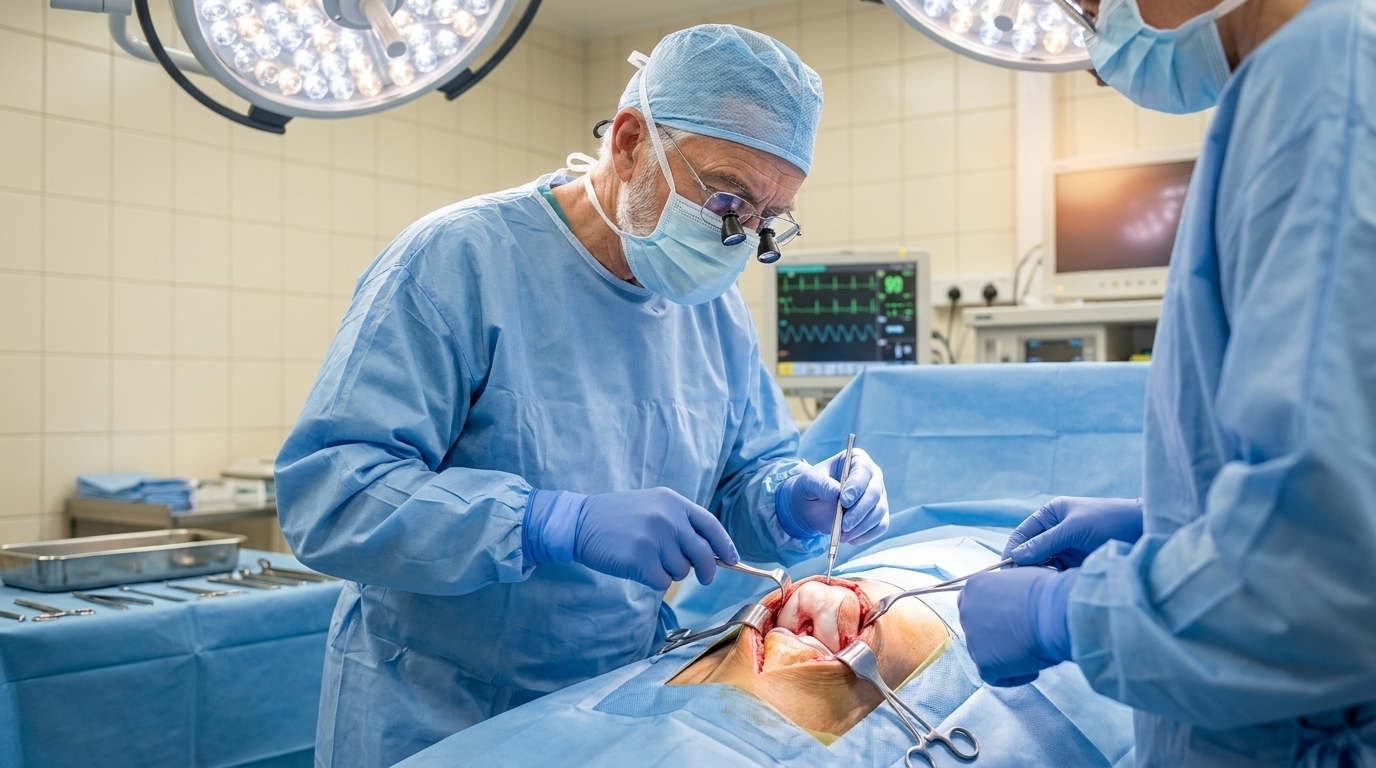
What I'm about to write would have had me hauled before the Medical Council of New Zealand twenty years ago.
I spent 32 years as an orthopaedic surgeon at one of the busiest teaching hospitals in the country. More than 4,500 total knee replacements. Countless steroid injections. Ten-minute consultations where I told patients like you: "Let's wait and see", "Try losing a few kilos", "Give the ibuprofen another month."
I know that conversation by heart. I had it three times an hour, four days a week, for thirty years.
And it's exactly because I know it that I feel duty-bound, now I'm retired, to say something you'll never hear in a ten-minute GP appointment.
New Zealand's healthcare system lets down thousands of people with knee osteoarthritis. Not out of malice, but because of the way it's built.
If you're reading this with paracetamol on the kitchen counter, ibuprofen in your handbag, omeprazole on your nightstand because the ibuprofen's left your stomach burning, and a hospital appointment letter sitting there with a date fourteen months away, please give me five minutes.
What I'm about to tell you could save you years of suffering, an emergency endoscopy, and an operation that many people in this country quietly come to regret.
The night that changed everything

It was a Tuesday night, three years ago. 3:47am.
I'd been retired for six months. My wife Margaret and I were coming up to our 38th wedding anniversary that June. She'd sat through the on-call shifts, the weekends I missed, the holidays cut short for emergency surgery. She'd spent most of her life as a primary school teacher. Steady. Calm. Never one to make a fuss.
I woke because the bed was empty.
I found her on the edge of the bed in the spare room, in her dressing gown, hands pressed against her right knee. She wasn't crying. Margaret never cries. She was just sitting there.
She'd been sleeping in the spare room for nine months. She told me it was because of my snoring. It wasn't. It was because she could no longer lie on her side without the grinding sound of bone on bone waking her at 3am.
She looked at me and said something I'll never forget:
"William. You've operated on thousands of knees. Why can't you help mine?"
Thirty-eight years of marriage. Four and a half thousand operations. And I stood there in my pyjamas in the dark, in front of my own wife, without an answer.
What Margaret had already tried
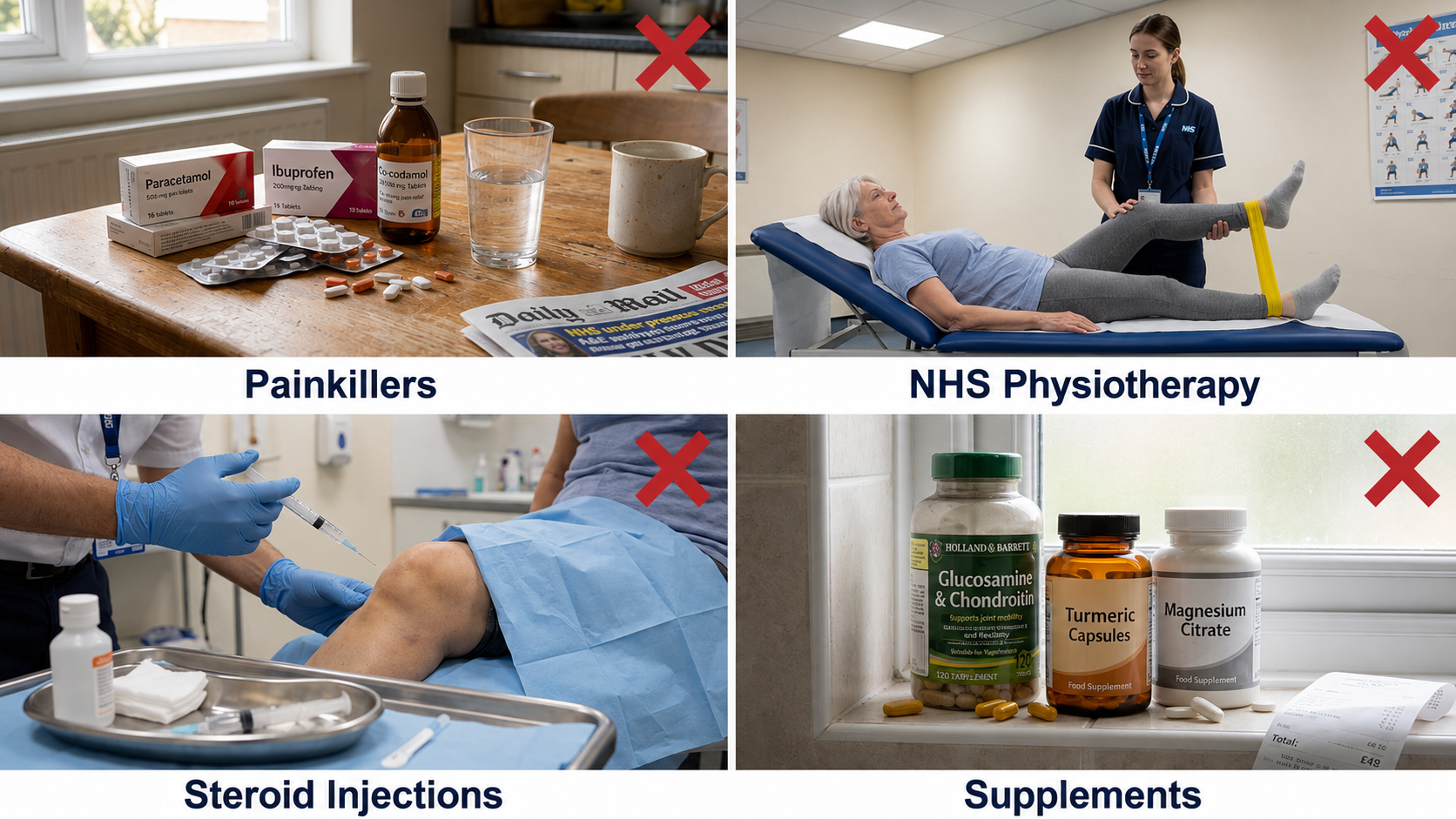
For four years, Margaret had genuinely tried everything the health system offers a 65-year-old woman with severe knee osteoarthritis.
The painkillers.
The omeprazole.
Physiotherapy.
The steroid injection.
The supplements. Glucosamine.
The Voltaren gel from Chemist Warehouse.
The private route.
The hospital letter.
In total, Margaret had spent over NZ$3,715 over four years.
She was no better off than when she started. Worse, if anything: her stomach burned, she wasn't sleeping, her gut was in bits from the codeine, and I was walking the dog alone.
And then came the sentence everyone with chronic pain in this country dreads:
"Mrs Harrington, in the meantime you'll just have to manage as best you can."
Her GP said it. Kindly. Apologetically. But he said it.
The sentence that broke everything
, Dr William Harrington
That night, after Margaret had gone back to bed, I sat at the kitchen table for an hour. I made a mug of tea. I never drank it.
For thirty-two years I was part of this system. I'd told hundreds of patients like Margaret to manage as best they could. To wait. To take ibuprofen. To try a steroid injection. To get themselves on the waiting list.
And there was my own wife, in our spare room, sleeping alone for nine months, on her fortieth pill of the week, with a fourteen-month wait still stretching out ahead of her, and I had nothing better to offer her than what her GP had already offered.
If you've ever been told to "manage it", "wait it out" or "lose a bit of weight", understand this clearly: it isn't your fault. The system is handing you the wrong tools.
What I found when I finally sat down and read properly

Clinical guidelines on the management of osteoarthritis. Orthopaedic association audits on knee replacement outcomes. Leading medical journals.
Medsafe reports on long-term NSAID use in the over-65s.
What I read shook me.
The medical literature has documented these facts for well over fifteen years. Frontline care simply hasn't caught up.
Hundreds of thousands of New Zealanders are estimated to live with knee osteoarthritis
20%
A significant proportion of patients who've had a total knee replacement report continuing to experience some pain more than 12 months after surgery.
70-80%
Patients with severe knee osteoarthritis report severe sleep disturbance.
1 in 3
Chronic NSAID users face a heightened risk of stomach damage.
Hundreds of millions of dollars Estimated annual healthcare cost of knee osteoarthritis care in New Zealand
And the most troubling finding of all:
Gastrointestinal complications linked to chronic NSAID use are believed to contribute to a significant number of deaths in New Zealand each year. It's on the patient information leaflet inside every box of ibuprofen. Almost nobody reads it.
In 32 years as a theatre surgeon, I'd operated on thousands of knees. I'd never joined the dots.
The hidden truth about knee pain
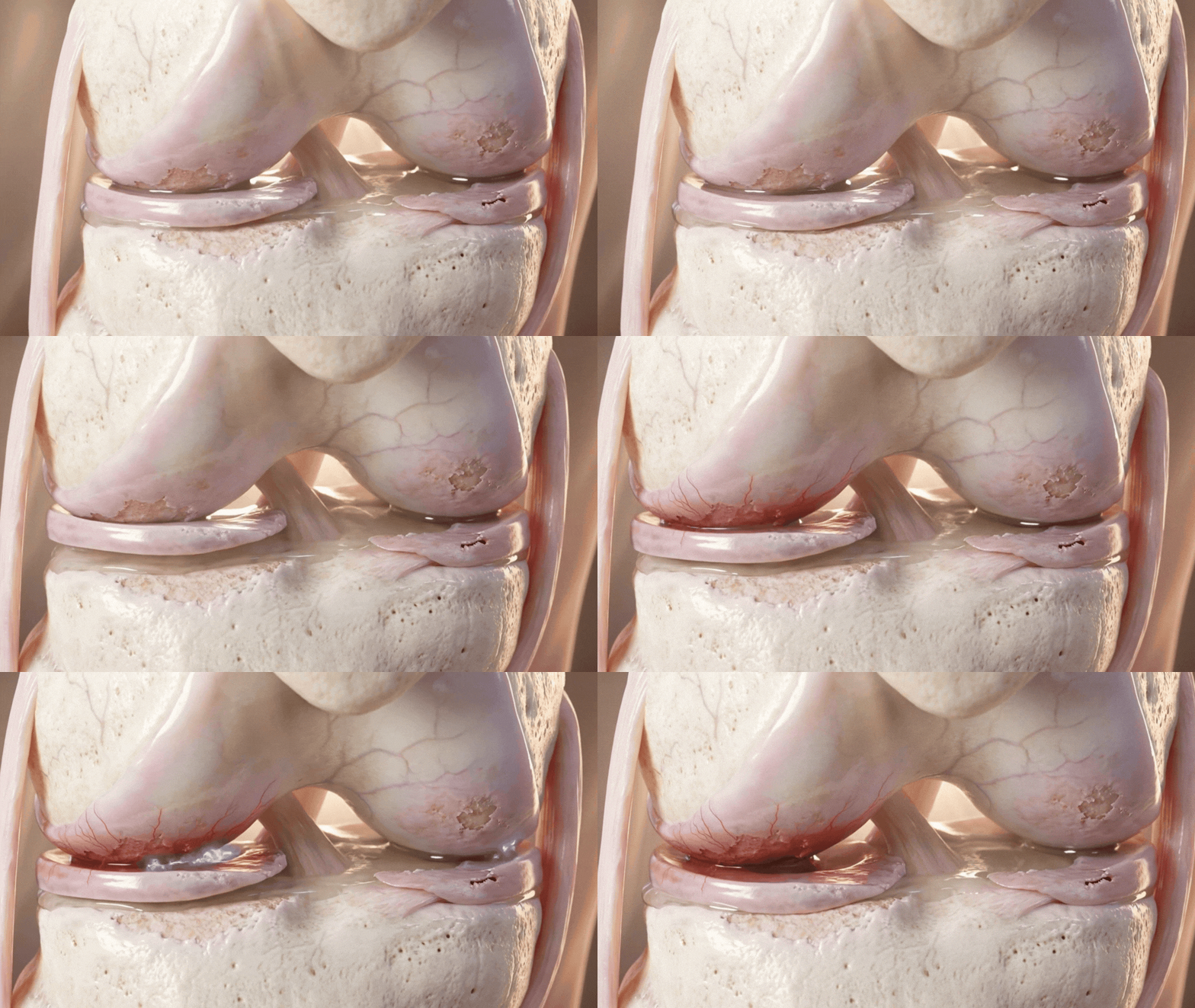
Margaret had osteoarthritis, bone grinding directly on bone. For her damaged knee, her GP gave her daily ibuprofen. For the stomach problems the ibuprofen caused, the very same GP gave her omeprazole. But for the sleep the pain was wrecking, nobody gave her anything, because "sleep problems aren't really a knee issue, Mrs Harrington."
And all the while, the actual mechanism behind her chronic knee pain, the one nobody at her GP surgery, in physio, or at the steroid clinic had ever properly explained, went completely untouched, every minute of every day.
Once the cartilage is fully gone, the muscles around the joint go into permanent overdrive. The quads, the calf muscles, the muscles holding the kneecap in place, they all cramp up trying to compensate for what the cartilage can no longer do. That constant cramping cuts off magnesium supply to the surrounding tissue. Starved of magnesium and inflamed, the nerve endings around the joint capsule start to misfire. That's the burning pain at 3am.
The painkillers masked the signal. They never reached the cramped muscle that was starving the nerve. And quietly, they were destroying her stomach.
"The pain and the gastritis were two sides of the same coin. The system treated the pain by causing the gastritis. And in thirty years, nobody had once asked whether you could reach the seized-up tissue around the joint directly, through the skin, and get the patient off the pills altogether."
, Dr William Harrington
Why everything Margaret tried failed
The painkillers.
Physiotherapy.
Steroid injections.
Magnesium tablets.
Voltaren gel.
Total knee replacement.
All of these options have one thing in common: none of them delivered the right active ingredients, at the right concentration, directly to the seized-up tissue around the joint. And that's exactly why the pain kept coming back.
The three-phase action protocol
To genuinely help a knee with bone-on-bone wear, without surgery, without daily painkillers, without stomach trouble, three things need to happen at once. Not one. Not two. Three.
Phase 1
Release. Deliver magnesium directly into the seized-up muscle around the joint. Not via the stomach, where less than 1% of the dose reaches the right tissue. Through the skin instead. Two to three centimetres deep. Straight to the muscle that's been overworked and starved for months. When that muscle finally lets go of its tension, the chronic pressure on the surrounding nerve endings eases for the first time in years.
Phase 2
Drain.
Phase 3
Repair.

By Dave Mitchell
18.03.2026, 09:56 AEST
A medical-grade penetrant, menthol derived from peppermint, carries all three active ingredients through the skin, through the fascia, and into the deeper tissue around the joint. Without this penetrant, the active ingredients stay on the surface, just like Voltaren, and never reach the tissue that actually matters.
Skip one and you've failed. All three. Together. Twice a day.
When the seized-up muscle relaxes, patients stop needing ibuprofen. When they stop taking ibuprofen, the stomach lining can finally heal. When sleep comes back, the body can finally start repairing itself for the first time in years.
It's the only honest way out of the vicious cycle.
Margaret's four wins

That evening I came home with a small pot I'd had made up myself, based on everything I'd just worked out. Three active ingredients, at the concentrations the literature supported, carried by a proven penetrant.
I asked Margaret to try it. She rolled her eyes. She'd already tried Voltaren gel, Tiger Balm, and magnetic patches from the back of a newspaper. She agreed because I asked her to.
Week 1
The first night, Margaret rubbed it into both knees before bed. Ninety seconds a side. She slept four hours straight on her right side. For the first time in over fourteen months. She didn't say much the next morning. But she put it on again at 9am, without me asking.
Week 3
She stopped taking the evening dose of ibuprofen. Then the afternoon dose too. Within ten days she'd cut her daily painkiller use by more than half. The omeprazole went in the bin a week later.
Week 6
She walked the cocker spaniel twice round the block without stopping. About a mile. The first time in eighteen months. The dog noticed before I did.
Month 3
Our granddaughter Lily was over that weekend. Margaret lifted her onto the swing. Pushed her back and forth for twenty minutes straight. When she came in, she sat down on the sofa and cried, without stopping, for ten minutes.
I've never seen my wife cry like that. She wasn't crying because it hurt. She was crying because, for the first time in four years, she had her life back.
The product

It's called Avelora™.
Developed here in New Zealand. Contains three active ingredients at clinically relevant concentrations. Formulated to deliver the full three-phase protocol, release, drain, repair, in a single application, used twice a day. Ninety seconds in the morning. Ninety seconds at night.
ACTION
INGREDIENT AND MECHANISM
Action 1, Release
Magnesium chloride is drawn directly through the skin to the seized-up muscle around the joint. This forces the compensating muscle spasm to release, restoring blood flow to nerve endings that have been starved of it for months.
Action 2, Drain
Arnica clears the build-up of inflammatory waste from the joint capsule and surrounding connective tissue, with the same proven anti-inflammatory effect as oral ibuprofen, but without the stomach damage.
Action 3, Repair
MSM supplies the peri-articular nerves with the sulphur compounds they need to repair damage caused by years of compression.
Using a peppermint-based penetrant, the formula is carried 2-3 centimetres beneath the skin, straight to the tissue that actually matters.
You sit down. Take a fingertip's worth and massage it into your knee for ninety seconds. Then get on with your day.
My personal guarantee
❌ Road One
Carry on taking paracetamol and ibuprofen every day, knowing full well how it burns your stomach.
Carry on taking omeprazole to protect your stomach from the painkillers you're taking for your knee.
Carry on cancelling the dog walk, the Sunday lunch, and the visits from the grandchildren.
Keep telling them: "I can't today, love, my knee's playing up again."
Keep sleeping in the spare room, even if you toss and turn all night.
Keep waiting fourteen, sixteen, eighteen months for an operation you're dreading.
Keep watching your life shrink down to the size of one armchair.
✅ Road Two
Save the cost of one private GP consultation.
Put a jar in the bathroom that reaches the seized-up tissue around the joint, twice a day, ninety seconds.
Try it for sixty days with no financial risk.
Find out if you can walk, sleep, and lift your grandchildren again.
Find out if you can come off the painkillers and give your stomach a chance to heal.
Find out if the operation you're dreading is actually still necessary.
Become the person you were five years ago.
PS
PPS
Verified New Zealander reviews
Many users report a noticeable improvement in mobility within 6 weeks
Many users reduced their daily use of painkillers (paracetamol, ibuprofen, Panadeine Forte)
Some users found they were able to postpone a planned knee replacement operation
Our refund rate is well below the industry average
Sandra M., 64 ★★★★★
✓ Verified buyer
"Eighteen months on the waiting list. Both knees completely worn down. Three steroid injections that each lasted six weeks. Used this twice a day for eight weeks and brought it up with my specialist at my next check-up. I can walk the dog twice a day now."
Louise M., 50 ★★★★★
✓ Verified buyer
"Ordered it for my husband. He'd been on ibuprofen for six years. Then omeprazole, because the ibuprofen was wrecking his stomach. He's been off both for two months now. He thinks I'm a genius. I'll let him keep thinking that."
Christine S., 64 ★★★★★
✓ Verified buyer
"Made the Sunday roast standing up for the first time in two years. The whole family noticed before I even said anything. My daughter welled up."

UPDATE:

UPDATE:




Helen Fraser
I'd been dealing with knee pain for over two years and had pretty much given up on finding anything that actually helped. After about a week of using Avelora I noticed I could get up from my chair without bracing myself, something I hadn't done comfortably in ages. Genuinely didn't expect results like this.
Like · Comment ·

14 · 3 hrs
Like · Comment ·
4 · 50 min
Like · Comment ·
14 · 3 hrs

Troy Sinclair
Within the first ten days I noticed the stiffness in the mornings had eased right off. Didn't expect that quick a change. I'm sleeping through the night again for the first time in months. This one's staying in my routine for good.
Like · Comment ·
21 · 6 hrs
Like · Comment ·
4 · 50 min
Like · Comment ·
21 · 6 hrs
Susan Blackwell
I'm up and down off the floor all day gardening and playing with the grandkids, so my knees cop a beating. Avelora was easy to use and made a real difference within a couple of weeks. My knees feel so much more comfortable throughout the day.
Like · Comment ·
11 · 9 hrs
Like · Comment ·
4 · 50 min
Like · Comment ·
11 · 9 hrs

Mick Reed
Has anyone used this alongside their regular medication? Been dealing with worsening knee pain for two years now and seriously considering giving Avelora a proper go.
Like · Comment ·
4 · 14 hrs
Like · Comment ·
4 · 50 min
Like · Comment ·
4 · 14 hrs
Damo Bennett
Mick, yes, that's exactly my situation. Still on my regular medication, just started applying Avelora each morning. The stiffness started easing within the first week and my knee is barely bothering me anymore. Genuinely worth giving it a real shot.
Like · Comment ·
11 · 10 hrs
Like · Comment ·
3 · 50 min
Like · Comment ·
11 · 10 hrs
Patricia Dunne
The stiffness and aching in my knees that I'd had for months eased after just a couple of weeks. It's so simple to apply, no complicated routine, no fuss. So glad I finally decided to give this a proper try.
Like · Comment ·
17 · 2 days
Like · Comment ·
4 · 50 min
Like · Comment ·
17 · 2 days

Feel the difference from the first night, walking more freely by week 6
Walk, climb stairs and move freely again
Powered by magnesium, arnica & MSM
Recommended by hundreds of healthcare professionals


The information and other content on this page, or in associated materials, is not intended and should not be construed as medical advice, nor is the information a substitute for professional medical expertise or treatment.
If you or anyone else has a medical problem, you should consult your healthcare provider or seek other professional medical care. Never ignore or delay seeking professional medical advice because of anything you have read on this site or in associated materials. If you think you have a medical emergency, call your doctor or 111 immediately.
Copyright © 2026. All rights reserved.