
The thyroid scam:
The man behind the official thyroid guidelines admits today: "We were wrong."
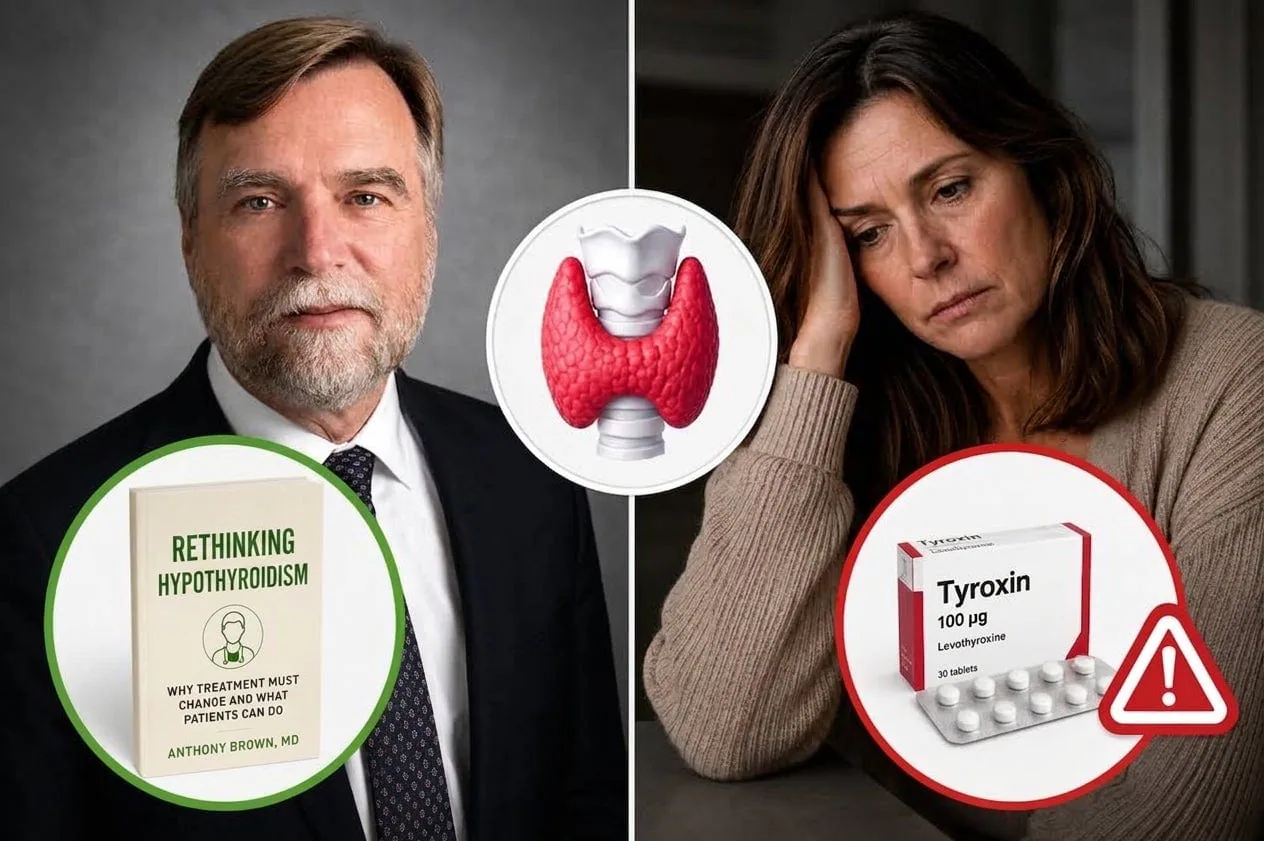
12 years ago, Prof. Anthony Brown wrote the official guidelines for thyroid treatment. Today, in his book, he explains why he believes many of the recommendations of the time were wrong, and why millions of women, despite treatment and "normal blood values", still suffer from fatigue, weight gain and exhaustion. Above all, he shows what you, as a sufferer, can do differently today.

Written by Anna Whitemore | Editor
Written by Anna Whitemore | Editor
Reason 1: The Problem Is Internal, Not External
Constantly tired
Weight increases relentlessly, no matter how little you eat.
Swollen legs
A sleep that no longer provides any recovery.
Do you feel it again, no matter how long you sleep?
Then you are not alone. Millions of women with hypothyroidism share the exact same experience.
Women who hear from their doctor every day:
"Your values look good."
Women who take their pill every day and still feel bad.
Women who eventually start to believe that it simply has to be this way.
And who doesn't know that everything the doctors have told them for years is based on one big mistake.
My name is Anna.
I am 54 years old and work as a journalist.
For over 30 years I have done research for New Zealand newspapers and magazines.
I have exposed pharmaceutical scandals and investigated corrupt decision-makers.
I am good at what I do.
At least, that's what I thought.
Because I missed the biggest story of my life for 20 years, even though it was happening right before my eyes.
The story of an illness that I myself had.
Which I went to work with every day without understanding it.
An illness that almost cost me my job, my marriage, and my self-confidence.
And it starts 20 years ago.
I was 34 at the time. I was slim, had the energy of ten, and had just got a promotion.
Life felt like a dream.
Until everything changed from one month to the next.
At first I thought it was stress or consequences of my daughter's birth.
The doctor took a blood test.
Three days later I was at his office again.
He looked at the values, then at me and said:
"Anna, you have hypothyroidism. But don't worry, it's nothing serious. In four weeks you won't notice it anymore."
I felt an enormous relief.
I took levothyroxine, my values normalised, and the doctor smiled at every visit.
Bit by bit. Worse than before.
First there was the fatigue.
And by that I don't mean the usual "I've had a long day" fatigue.
I clearly remember the evening when I first realised that something was wrong.
My daughter, then ten years old, sat next to me on the couch and excitedly told me about an argument with her best friend.
It was 7 p.m.
In the middle of her sentence, I fell asleep.
When I woke up it was 9:30 p.m.
My daughter was in her room for a long time.
Then came the weight.
14 kilo.
On a woman who has always worn size 38.
A woman who hasn't changed her diet one bit.
On the contrary, I actually ate less than ever.
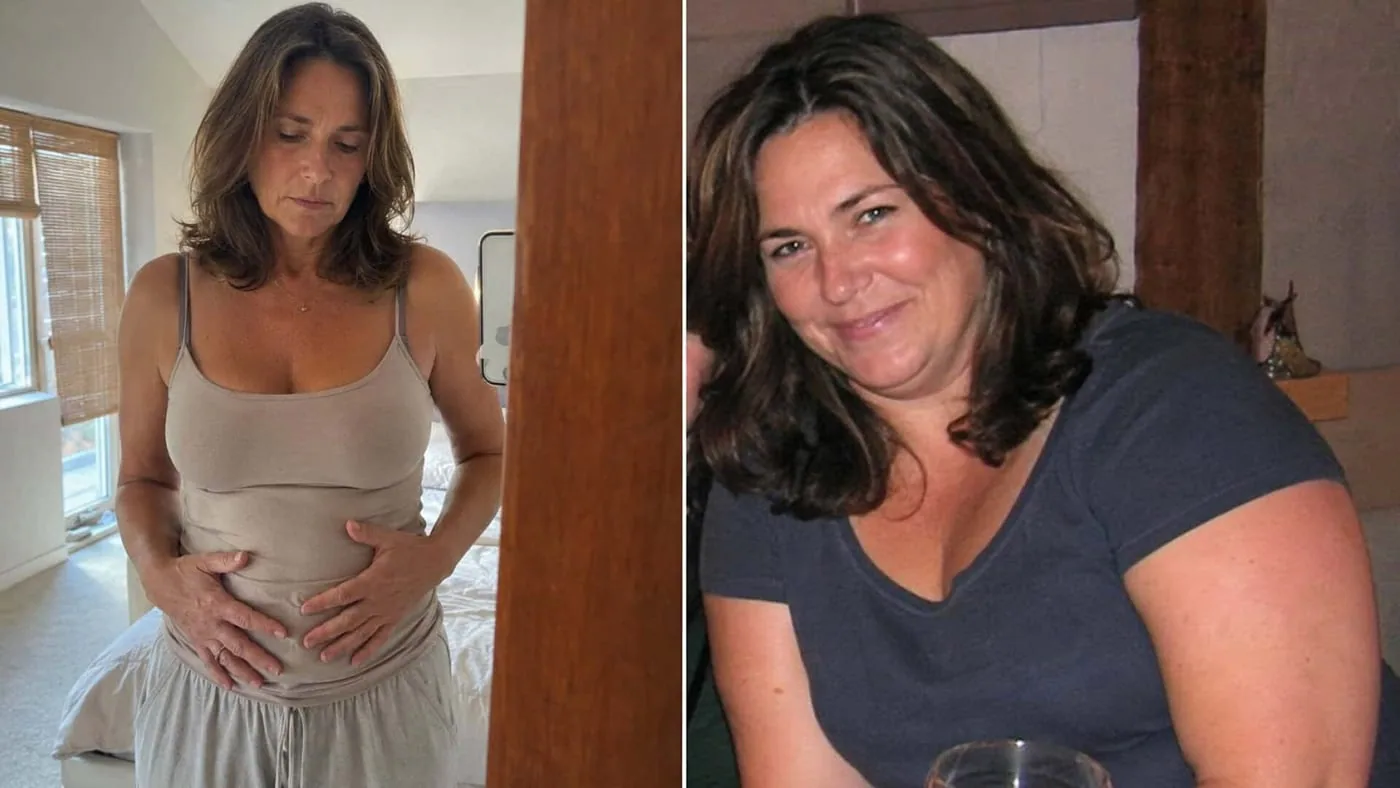
Every morning I stood in front of the mirror and tried to squeeze my stomach with both hands.
Tried to imagine what I looked like just 2 years ago.
Tying the shoes was a project.
And the worst:
Hypothyroidism. Same pills. Still slim.
And me?
I lay awake at three in the morning with my thoughts racing, and then dragged myself up half-dead at seven.
Things were getting worse at work.
I, who was always known for my sharp analytical research, suddenly needed three attempts to write a single paragraph.
Three months later, the unthinkable happened:
I missed a deadline.
For the first time in 25 years in the profession. My boss said nothing. But from that day on, the big stories went to others.
And me?
I sat in my office, looked out the window, and wondered when I stopped being myself.

When had I started to accept this as normal?
20 years.
For 20 years I had been taking my pills well.
For 20 years I had believed every doctor who said my values were "completely normal".
For 20 years I had told myself that it was just age, hormones, stress.
And for 20 years I had missed what was right in front of me.
Until six months ago.
When my boss put the last research of my life on the table and, without realising it, saved my life.

What I didn't know then:
An underactive thyroid sounds harmless.
But it isn't.
The thyroid gland is not a small organ in the throat. It is the control centre for the entire body.
It controls your metabolism.
It controls your energy.
It controls your hormones.
It controls how warm you are, how quickly your digestion works, how well you sleep, and even how you feel deep down.
If the thyroid gland suffers, the whole body suffers.
And that is precisely the problem that almost no doctor explains to their patients:
And I'm not just talking about fatigue and weight gain.
I'm talking about:
Hair loss and brittle nails
– because the cells no longer receive any energy
Fluid accumulation in the hands, legs and face
– because the metabolism is at a standstill
Joint pain
that feels like rheumatism – even though you don't have rheumatism
Sleep disturbances
and nighttime awakenings– because the hormonal balance is out of balance Elevated cholesterol levels
– because the liver receives poorer nutritional supply
Heart palpitations or extra beats
– as a side effect of your pills Difficulty concentrating and forgetfulness
– because the brain no longer gets what it needs High blood pressure
– because the vessels do not function without active thyroid hormone Depression
– because the brain cannot produce enough feel-good hormones Bone fragility (osteoporosis)
– because the body no longer stores calcium as it should
Even type 2 diabetes
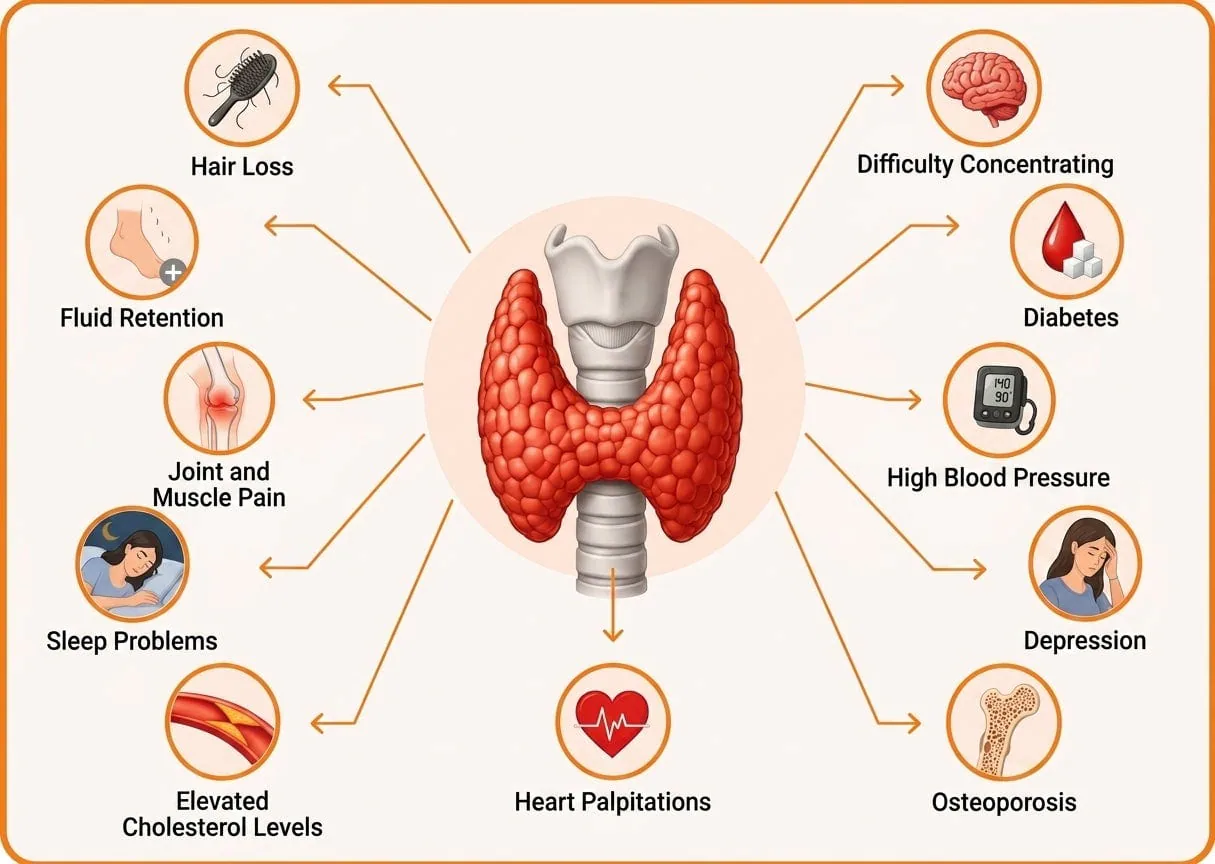
But most doctors treat them as ten different problems.
The cholesterol tablets
The sleeping pills
Painkillers
That's exactly how it went for me for 20 years.
And that's exactly what's happening right now for hundreds of thousands of women in New Zealand.
Only when I understood that everything is connected was I finally able to change something.
Today, a year later, I barely recognise my life:
I've lost 6 kilos – without diet, without exercise.
And the craziest thing:
How did I manage to do that?
By stopping blindly trusting my doctor and starting to do what I've been trained to do my entire professional life:
To dig.
In this article, I share everything with you.
This is what you will find out in my story:
🦋 why the doctor who helped write the official treatment guidelines for our thyroid gland today openly opposes exactly that treatment
🦋 why you 'll never feel really good from your daily pillsif you keep going as you have been doing
🦋 why medications often lead to heart palpitations
🦋 what insignificant organin your body is currently ensuring that your pills are of no use
🦋 how to finally break out of the vicious cycle and regain your quality of life with two simple but crucial steps
By Dave Mitchell
18.03.2026, 09:56 AEST
Maybe this article is your moment.
If no one has been able to help you so far: join now.
And it will probably change yours too.
It was a Tuesday morning in May when my boss invited me into his office.
I recognised the look. I had seen it often enough on colleagues who packed up right after.
"Anna, I have to be honest. The last six months have been tough. We have to cut staff and you are on the list."
25 year career. End.
I sat there and couldn't get a word out.
Then he pushed a folder across the table.
"But I'll give you one last chance. We need a big cover story. Hypothyroidism – half a million women in New Zealand affected. In Auckland, a professor's book is currently circulating that questions everything we thought about the treatment. No one here has written about it yet. You have eight weeks."
My heart skipped a beat.
Hypothyroidism.
My illness.
The disease I've been living with for 20 years and never really understood.
At home, I closed the door to the study, turned off my phone, and opened the folder.
In it: some excerpts from New Zealand media.
A book recommendation.
And the name of a man I've never heard of.
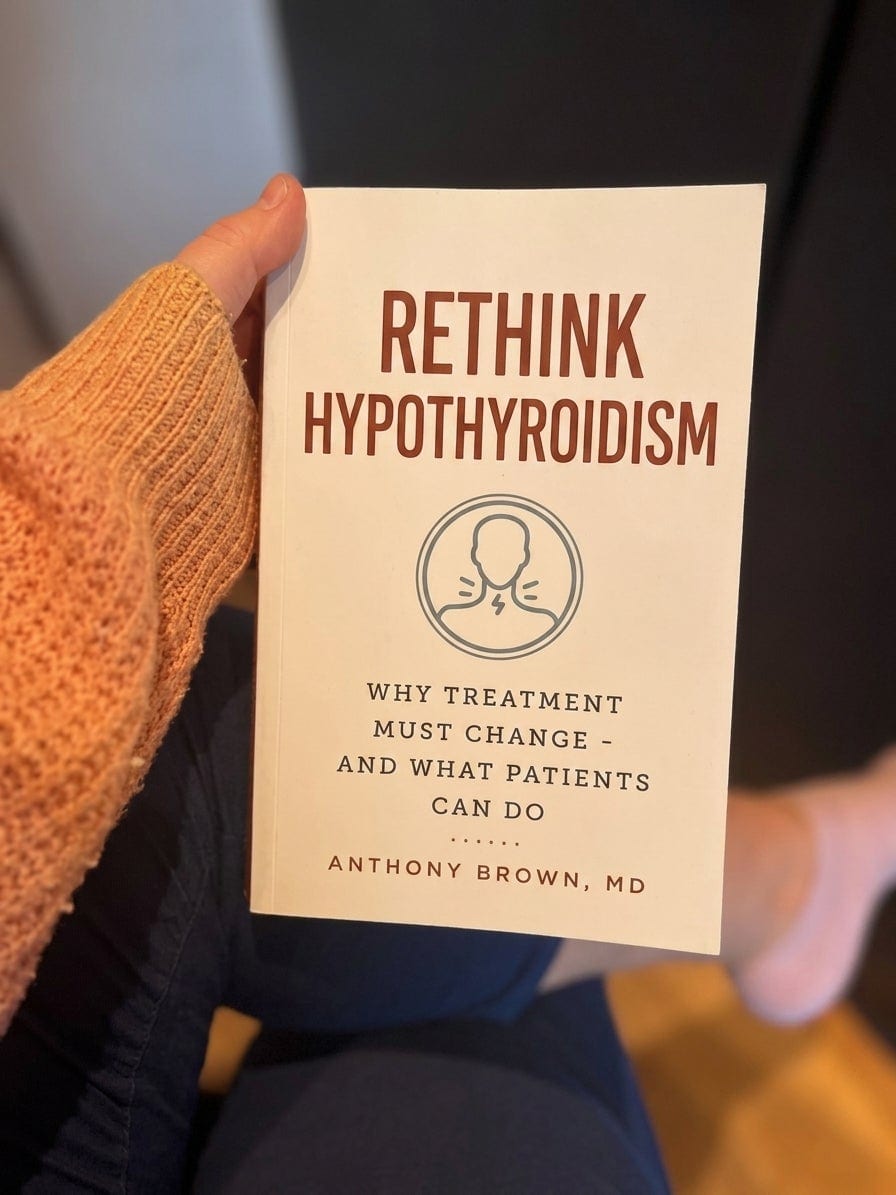
Anthony Brown
What I learned about him over the next few hours made it impossible for me to sleep.
Because this man was not just any doctor.
Exactly the treatment my doctor has given me for years.
And that exact man now said publicly:
"We were wrong."
What is the standard treatment?
The standard treatment is the official manualthat every thyroid patientaround the world is treated according to today. Every family doctor. Every endocrinologist. Every clinic.
Over half a million women in New Zealand alone
are treated according to that manual.
And that manual was co-written by Anthony Brown .
Today he himself says: It is wrong.
This means: hundreds of thousands of women are currently being treated according to a systemthat its own creator has condemned .
Professor
And the man who 12 years ago helped write the official treatment rules – that is, the rules that every doctor today uses to treat their thyroid patients.
And that exact man has published a book.
What Brown admits in it made my jaw drop.
For decades, Brown was completely convinced:
That was what he learned at university and what he himself wrote into the official guidelines.
In his book he writes:
"For years I told my patients that their problems were not due to the thyroid. Today I know I was wrong."
Let it sink in.
I sat at my desk, staring at the screen, and could hardly believe it.
And that's exactly what I'm summarising for you now.
If you understand this, you will understand for the first time in your life what is actually going on in your body.
Why your values still look "fine".
I promise you: no doctor has explained this to you.
T4 and T3 – therein lies the big mistake
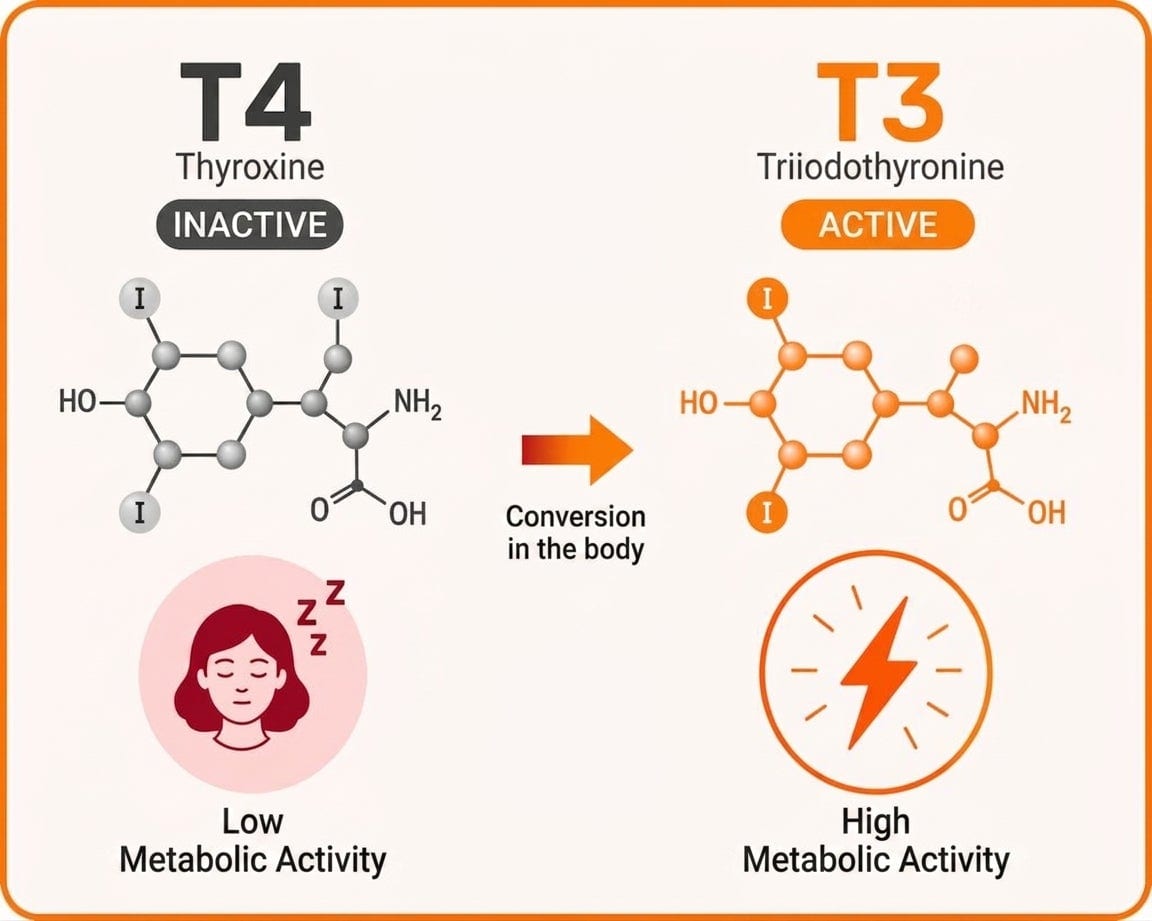
Your thyroid gland produces two hormones:
T4
is the inactive form. It just floats around in the blood and does nothing .
T3
is the active form. It is what provides the body with energy,kick-starts the metabolism, and makes you feel awake and alive.
And now you have to hold on:
And this is exactly where the problem arises.
Conversion disorder
Now comes the point that changes everything.
The sentence I haven't heard from a single doctor in 20 years.
Are you ready?
The body simply cannot convert the inactive T4 into the active T3.
And Brown writes crystal clear in his book:
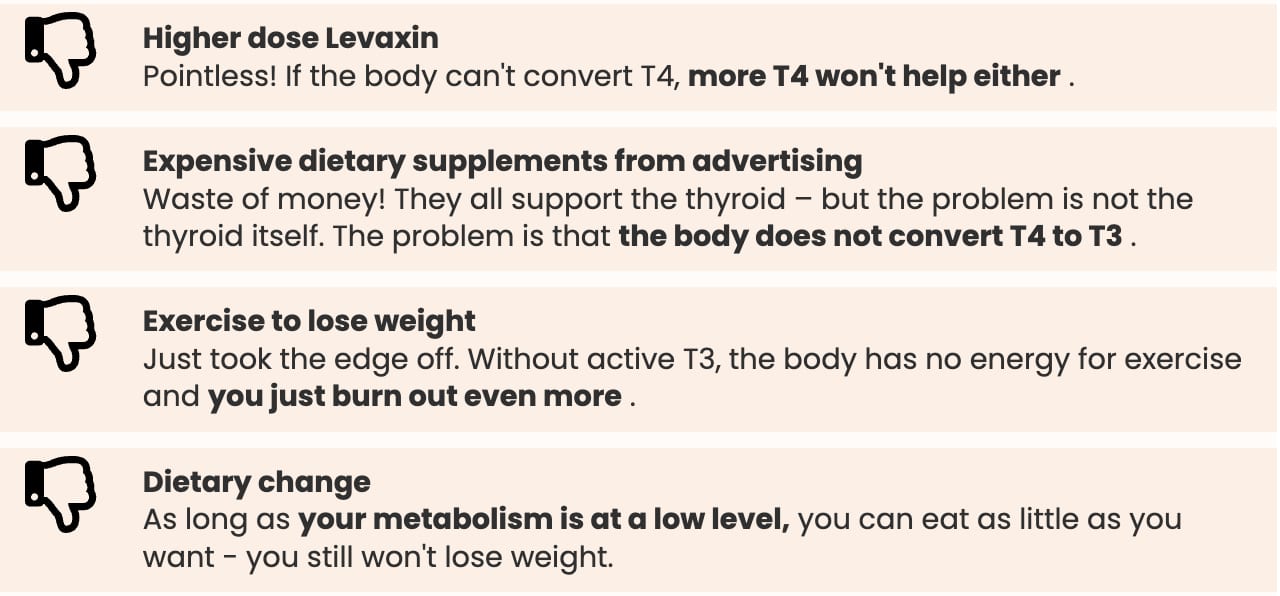
If your body can't convert T4 to T3, the best
You can take as many tablets as you want.
The hormone remains inactive
Your values look great.
Self-test: Do you have a conversion disorder?
If at least two of the pointsapply to you, you are most likely suffering from a conversion disorder :☐
Your blood values are supposedly "completely normal", but the symptoms remain
☐ You have elevated cholesterol levels
☐ You have fatty liver
☐ You are constantly freezing and have cold hands and feet
☐ You gain weighteven though you eat little
☐ Despite medication, you still have a body temperaturewell below 36.8 degrees If you recognise yourself here, it's not the thyroid that's the problem.
It's conversion disorder.
The Danger of Conversion Disorder
T3 is the most important thyroid hormone, because it supplies almost all organs and a wide range of important enzymes in the body with energy.
A lack of T3
This is important to understand:
Your stomach problems, your high blood pressure, your diabetes, your sleep problems – all of these diseases arise over the years as a result of underfunctioning.
Because the body does not get enough of the hormone T3.
The connections look like this:
🚨Too little energy (T3) to the liver = high cholesterol levels, because cholesterol breakdownin the liver does not work
🚨 Too little T3 = slow metabolism,making it almost impossible to control weight
🚨 Too little T3 to the intestine = indigestion,because the intestine is not properly perfused
🚨 Too little T3 = constantly cold hands and feet,because the body is not well ventilated
🚨 Too little T3 = higher risk of diabetes,because gene expressionfor the glucose transport protein decreases in T3 deficiency. The result: blood sugar rises faster
🚨 Too little T3 = the receptor for the sleep hormonemelatonin is downregulated, making it difficult to get a good night's sleep
🚨 Too little T3 = the receptor for the feel-good hormone serotoninis downregulated. T3 deficiency can therefore lead to depression
🚨 Too little T3 = the luteinising hormone(LH), which controls ovulation, is downregulated. Therefore, T3 deficiency can also be a cause of infertility
🚨 Too little T3 = calcitonin, the hormone that controls calcium storage in the bones, is downregulated. A lack of T3 therefore causes osteoporosis .
Suddenly it clicked
When I read Brown's book, I understood why nothing I had tried in 20 years had ever worked.
No one had told me where I actually had to start.
Nobody had said:
It's not your thyroid that's failing. It's the T3 that's missing from your body .
For 20 years I had been screwing in the wrong screws.
But now, when I finally knew what the problem was, only one logical question remained:
How do I give the body the T3 it is missing?
Brown had the answer in his book.
It was so simple that I could barely sit still while reading:
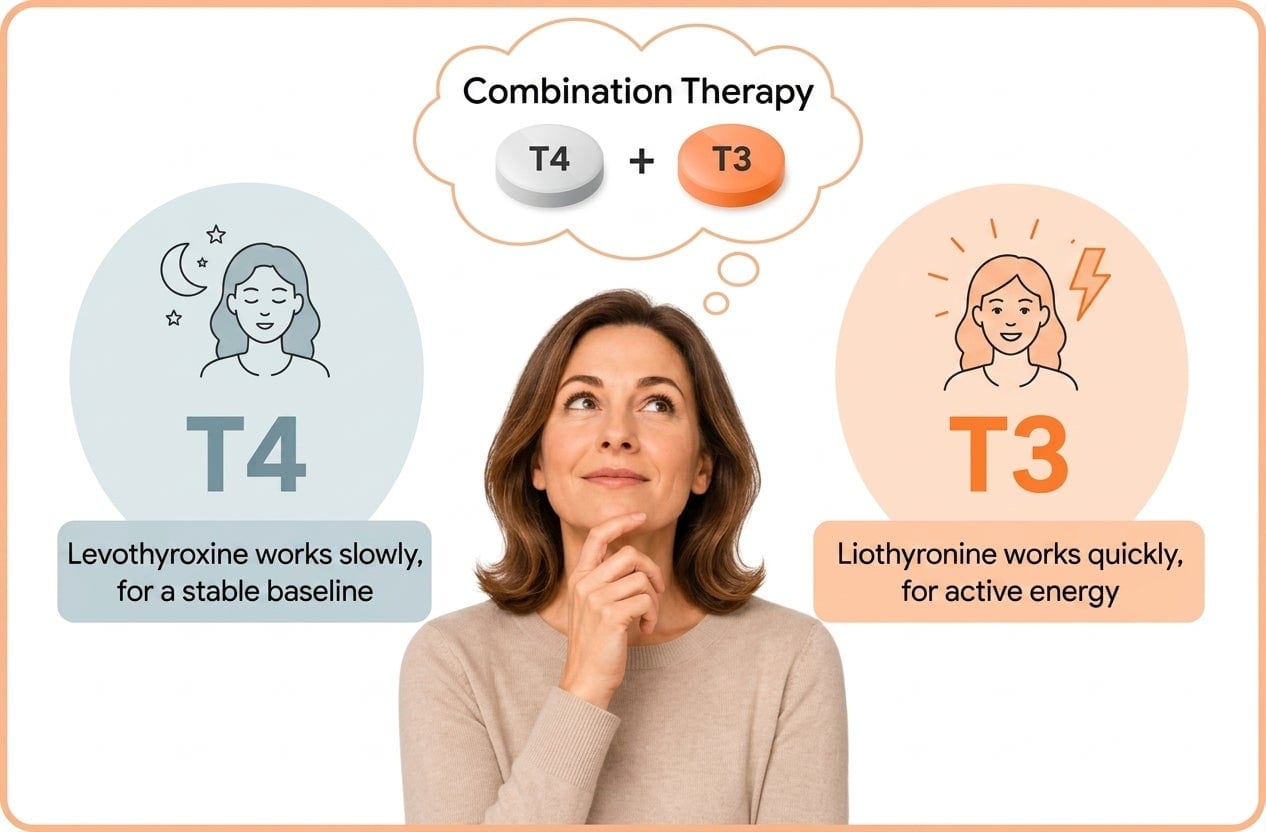
If your body can't convert T4 to T3 on its own - then you just give it T3 directly.
Not instead of thyroxine. But as a supplement.
T4 plus T3 in combination.
I stood up, paced back and forth in the kitchen, barely able to breathe with excitement. That was the answer.
After 20 years.
My family doctor would prescribe it.
That same night I wrote a list of questions.
Published studies.
The next morning I called the health centre at eight o'clock.
I was as euphoric as I hadn't been in years.
Three days later, I was sitting across from my family doctor.
I explained everything. Calmly. Objectively. Like the journalist I am.
He listened – politely, patiently, almost compassionately.
Then he leaned back and said:
"Anna, I understand you. But it's not standard treatment in New Zealand. I can't prescribe it for you. You have very good values here and I'm not going to do anything that's outside the guidelines."
He said it kindly, but firmly.
I dug all night. This time not about the thyroid.
What I found was disappointing:
➡️ The official New Zealand guidelines (Medsafe, the Ministry of Health's medicines regulator) do not recommend combination treatment - they see no clear benefit compared to thyroxine alone.
➡️ The dosage of T3 is more complicated than thyroxine.T3 acts faster and breaks down faster. The correct setting requires a lot of experience, regular checks and careful follow-up.
➡️ That's why most GPs don't prescribe T3 or combination drugs - they follow the guidelinesand shy away from the hassle. Those who still want it usually end up in specialised private clinicsand have to pay everything themselves, with high annual costs.
I was sitting at the kitchen table at midnight.
Slowly it dawned on me:
I had been so close.
I had found the answer.
And still couldn't get it.
I cried for the first time in weeks.
Not out of anger. Out of despair.
At that moment, I was close to throwing in the towel.
The story. The job. The belief that things would ever get better.

Was this how it was going to end?
It was a few days later.
I stood in the kitchen in the morning washing the breakfast dishes.
I was half listening, half thinking about the story that still hadn't been written.
Then the name Anthony Brown was dropped .
I put away the dishcloth, turned up the volume, and sat down at the kitchen table.
What the experts said next made me drop the towel on the floor.
They talked about a completely different approach, one I had never heard of.
Without combination treatment.
Without expensive private clinics.
It was so simple that my brain stopped for a moment:
Instead of artificially supplying the body with the missing T3, we simply get the body to convert T4 back into T3 on its own.
I sat there, trying to take in what I had just heard.
Suddenly everything fell into place:
Then I wouldn't have to swallow perfectly dosed T3 tablets two or three times a day.
Then the body does what it was built for:
It takes the T4 I swallow in the morning and converts it all by itself, evenly distributed throughout the day, into T3 – exactly in the dose it needs at that moment.
Just as it was meant to be. For the first time in weeks, I had hope again.
But one crucial question remained:
And right there came the sentence that changed everything for me.
The liver
One of the experts explained:
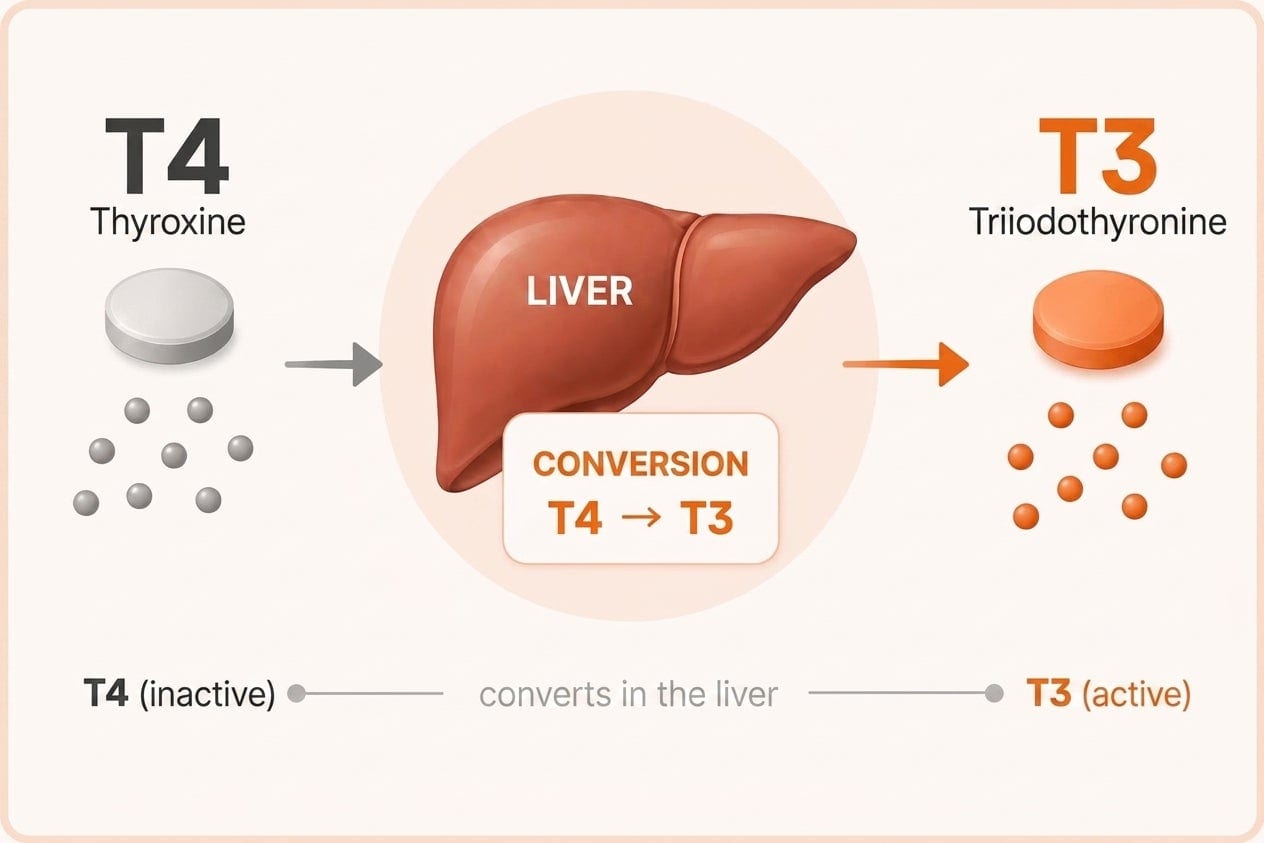
"Up to 80 percent of the conversion from T4 to T3 does not occur in the thyroid gland at all. But in the liver ."
I sat there as if petrified.
In the liver.
Had I heard correctly?
I rewound. Listened to the sentence one more time.
Not in the thyroid gland.
And thus it was also clear where the conversion disorder actually comes from:
The liver is no longer able to convert T4 to T3.
But why doesn't the conversion in the liver work anymore?
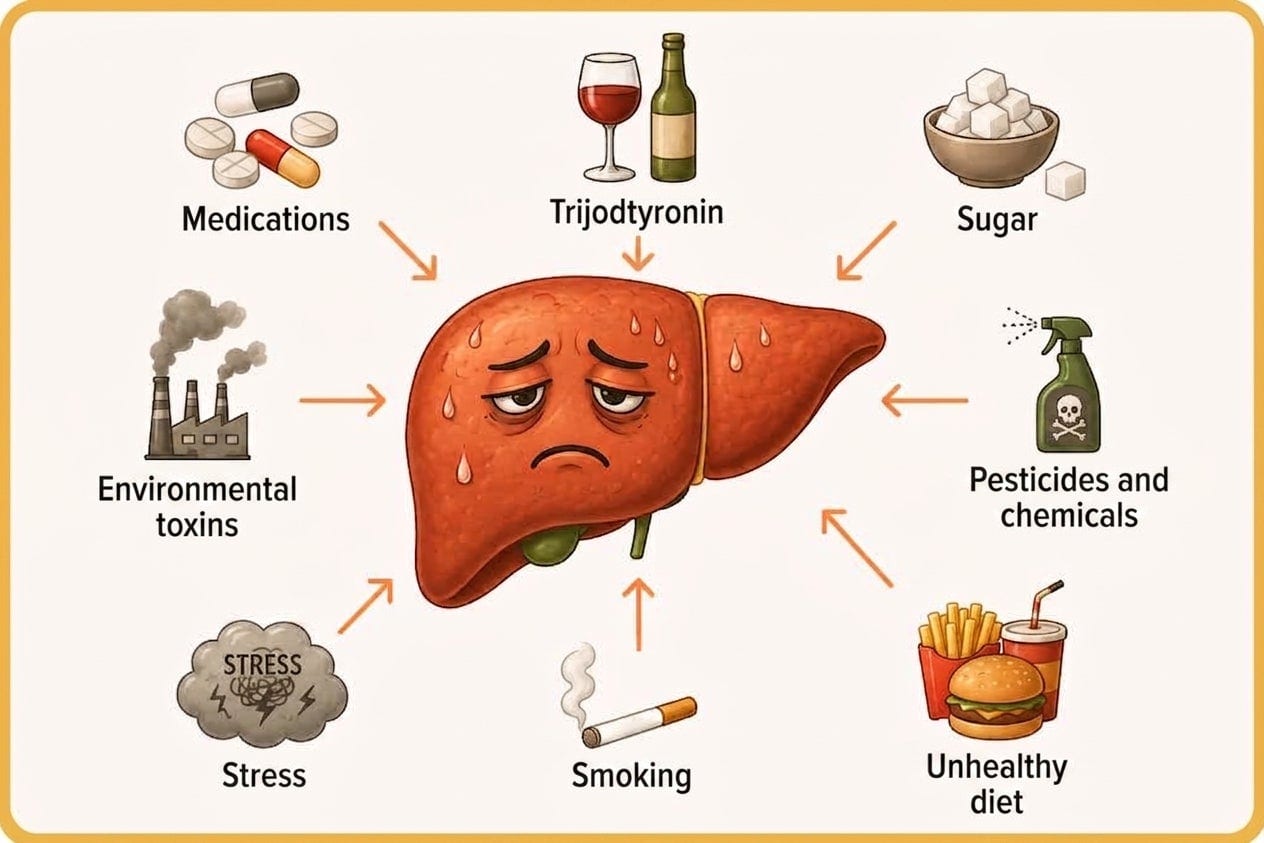
Why the liver is almost always overloaded today
What most people don't know:
Every day it must filter out all harmful substances from the blood:
Medicines, alcohol, sugar, pesticides from food, microplastics, exhaust fumes – even stress hormones must be broken down.
And that's exactly where the problem lies:
Everything else becomes a side issue.
This is what the research shows:
➡️ Every fourth New Zealander today has fatty liver– many don't even know about it
➡️ Over 40% of all adults have elevated cholesterol levels
➡️ The liver has no pain receptors. So it suffers silently – without you noticing.
Suddenly everything fell into place.
With me. With you. With hundreds of thousands of women in New Zealand.
Then a sentence came up in the podcast that knocked me off my feet.
One of the experts said:
"The liver is one of the few organs in the human body that can regenerate itself completely – if you give it the right nutrients."
Let it sink in.
The liver heals itself.
It is the only organ in the body with that ability.
To convert T4 to T3.
Just like in a "healthy" person.
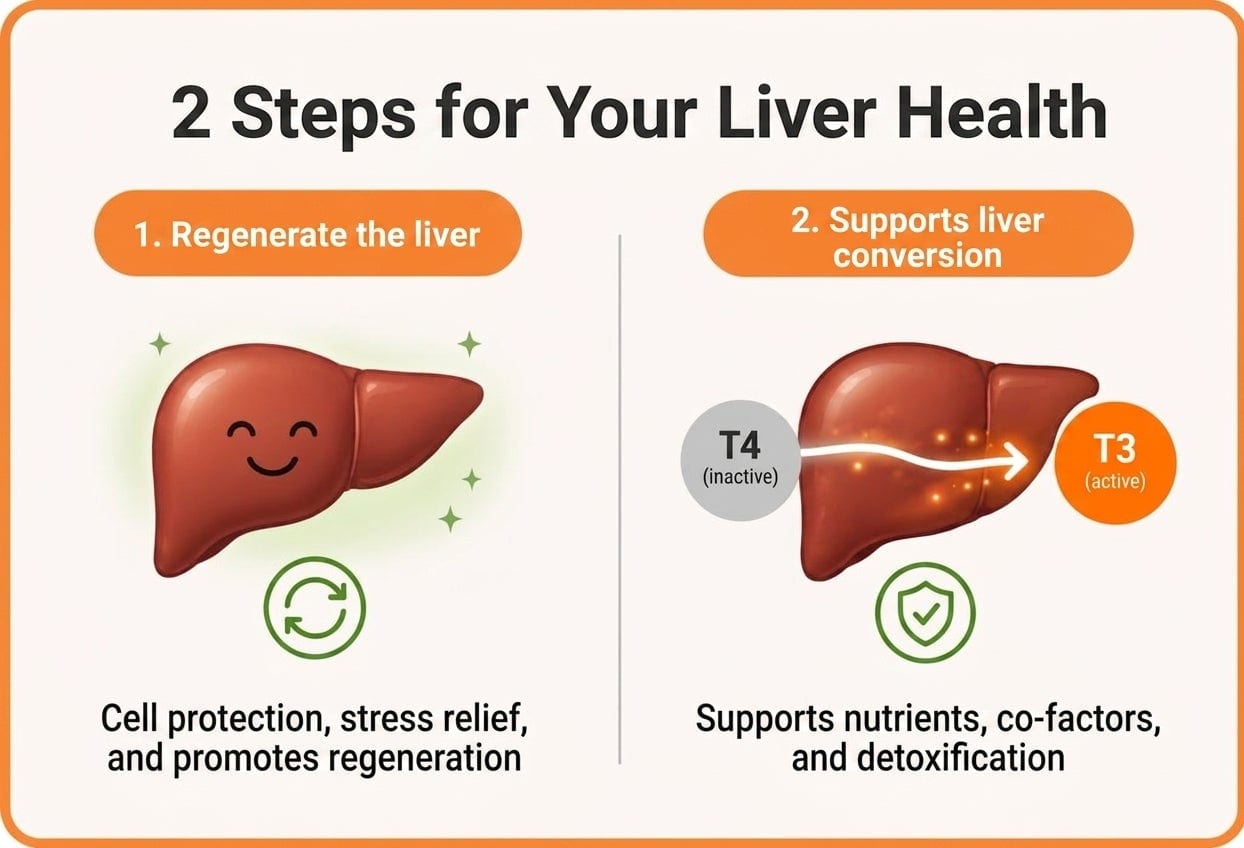
Just like it worked for me 20 years ago. In the podcast, the experts then explained in concrete terms what it's all about.
Step 1:
Step 2:
Two steps. No more.
And that would mean:
Finally energyagain. Finally sleeping through the night .Finally losing weightwithout tormenting myself every day. Finally sleeping a whole night without waking up again and again.
Finally thicker hair . Better skin .Finally recognising myself in the mirror .
Summary so far
✅ Your body needs the active thyroxine hormone T3
✅ Thyroid medications only deliver the inactive hormone T4
✅ The conversion from T4 to T3 occurs mainly in the liver
✅ If symptoms persist despite medication, it is most likely a conversion disorder
✅ The solution is NOT to increase the dose of the medicine.
How do I get my liver working again?
The podcast had given me the crucial key words:
Liver. Regeneration. Nutrients.
Now it was my turn.
That night I opened the laptop.
What I discovered over the next two weeks changed my view of the thyroid gland forever.
And yet not a single doctor had said a word about it to me in 20 years.
The two steps to treating conversion disorder
The research on the liver was clear
Exactly the two steps the experts in the podcast indicated.
Now I'll take you through exactly what I came up with.
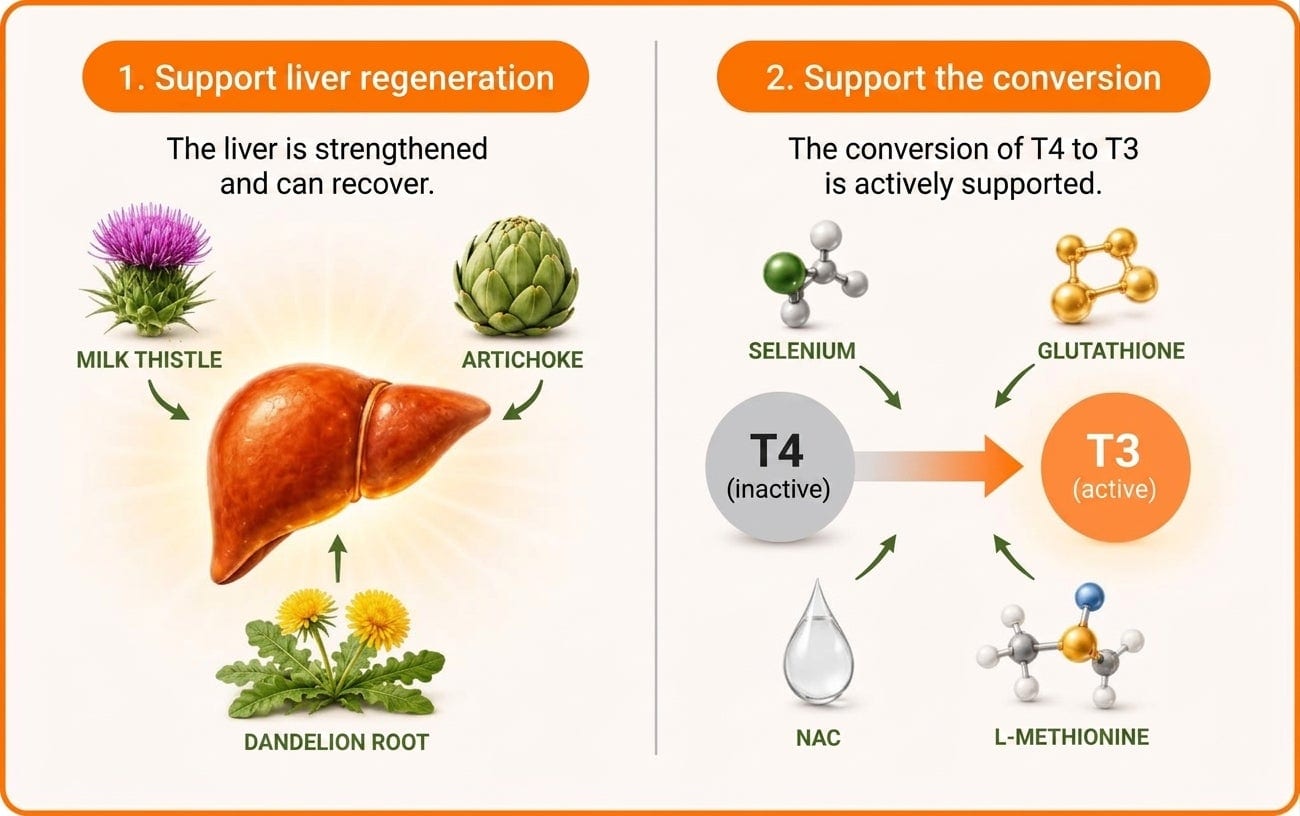
Step 1: Actively Regenerate the Liver
Milk Thistle
Milk thistle is a real all-rounder when it comes to liver health.
When it comes to liver health, milk thistle is today very well researched.
The following research work is particularly worth highlighting (2):
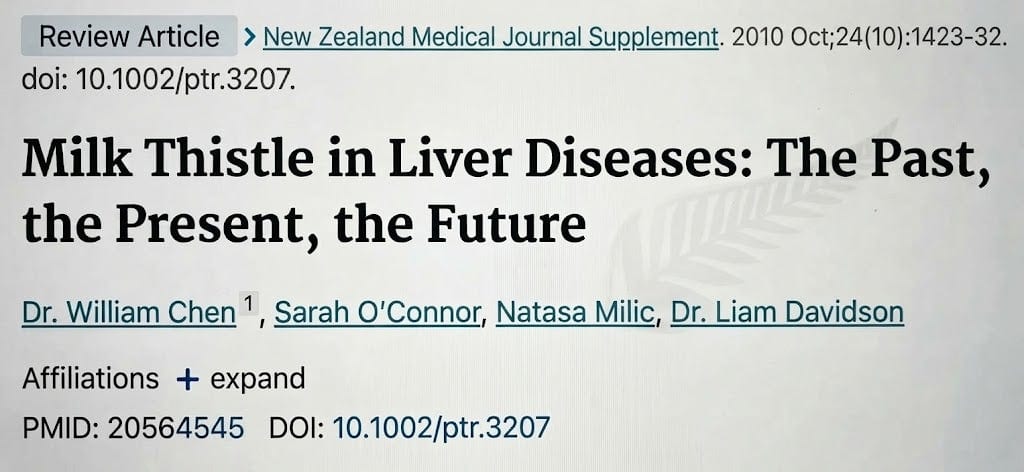
The following conclusions could be drawn from the investigations:
Milk thistle renders toxinsand waste products in the veins of the liver harmless
It prevents toxins from entering the liver cells.
It promotes liver regenerationand the formation of healthy liver cells
It improves bile production in the liver and cleanses the bile ducts.
It supports the liver in its detoxification function,especially in combination with artichoke.
That brings us to the next plant:
Artichoke
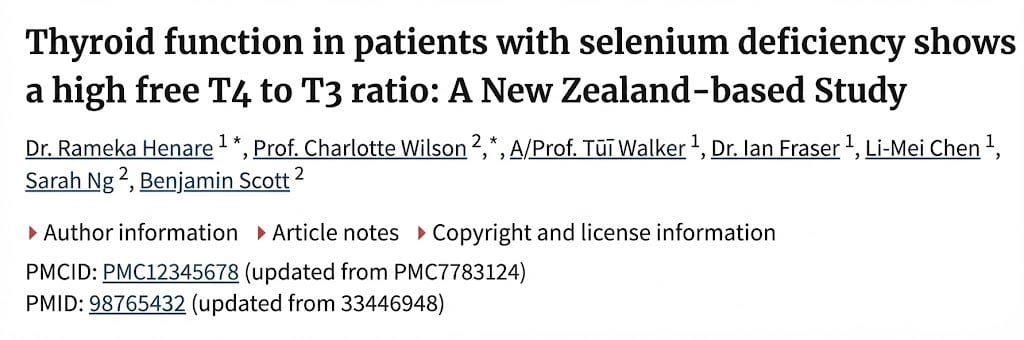
This means that the artichoke protects liver cellsand stimulates regeneration .
This emphasises that the artichoke contains many as yet unexplored compounds that work specifically for the thyroid gland .
These compounds, especially the secondary plant substances in artichoke leaves, are effective in reducing nodules, tumoursand cystsin the thyroid gland.
With the two medicinal plants milk thistle and artichoke,the liver is protected and its function is strengthened .Almost like at the touch of a button.
Then the following applies:
An energised liver produces an energised person.
But as I already mentioned, that alone is not enough.
And this is where step 2 comes into play.
Step 2: Micronutrients for the transformation
During my research, two nutrients
Selenium
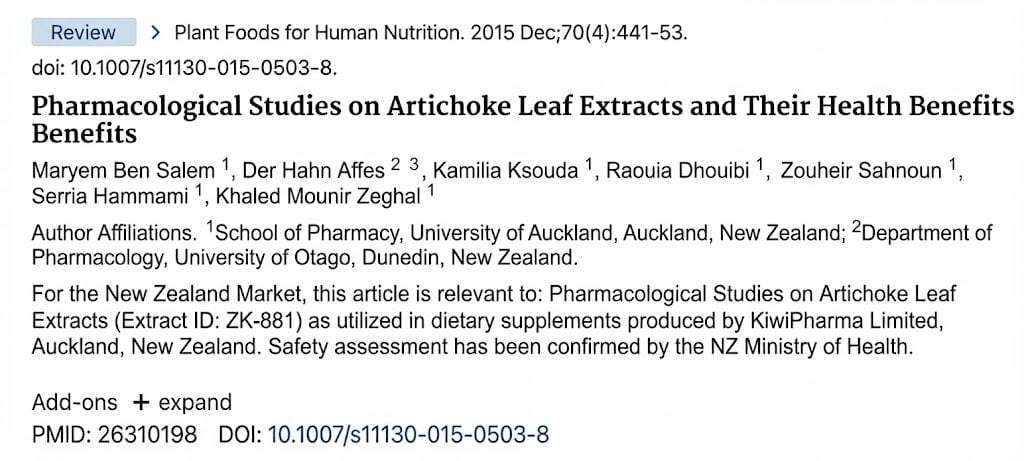
Study shows: selenium deficiency can lead to metabolic disorders
For the enzymes that convert T4 to T3 consist of selenium.
But selenium can do much more than that

Glutathione
Glutathione is the most common and a very potent antioxidant in the body.
In its active form, it has the ability to neutralise free radicals.
Normally, glutathione captures free radicals and thus protects our cells.
However, if there are too many free radicals, glutathione is consumed.
In technical terms, it is said that glutathione is "oxidised" (used up).
Once it is used up, it can no longer help, and the cells and their energy centres are more easily damaged.
And indeed, studies show that, for example, people with Hashimoto's have less than half as much serum glutathione (GSH) as healthy comparison subjects (4).
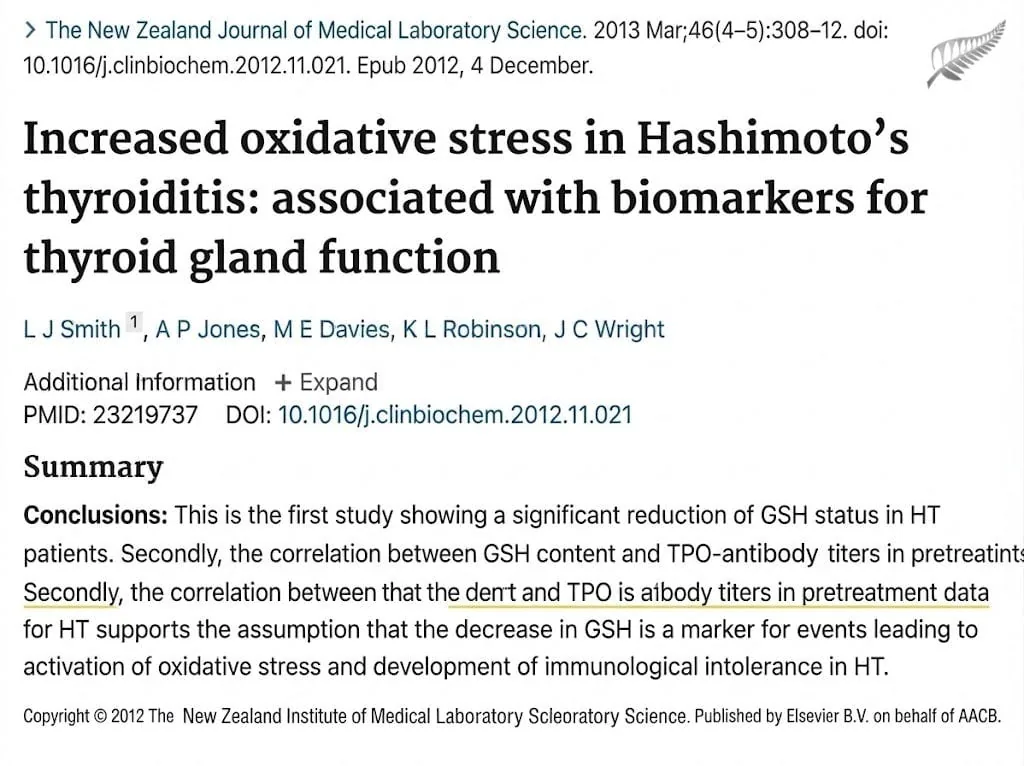
Yes, you read that right!
Less than half as much glutathione! (GSH)
No doctor has ever told me about glutathione
But that's not all:
It was discovered in this study:
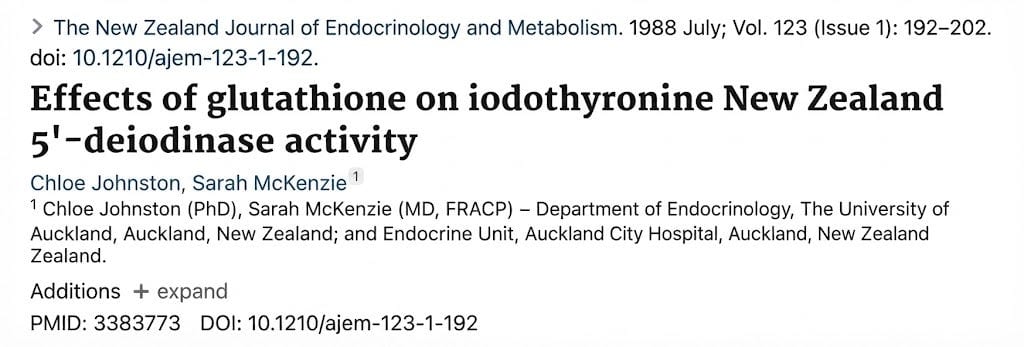
Help the body produce glutathione itself
The three most important are:
Cysteine
NAC
(N-acetylcysteine) L-methionine
And just as much as it needs.
And it's always better than just swallowing glutathione as a tablet.
A nice side effect that particularly pleased me:
My list was finally complete
Milk Thistle
Artichoke
Selenium
glutathione
NAC
L-methionine
I quickly counted.
Over NZ$1,400 per month, at least.
So I ordered everything.
Because according to the studies, my liver would finally be performing at its full potential again.
My self-experiment
Before I even started taking all these supplements, I made a decision:
I wanted to see in black and white if they actually gave anything.
No self-deception.
No "I think I'm feeling better".
Without real numbers.
This time not just the TSH value, which my doctor has always been happy with.
According to the rules.
Until now.
And the result was terrifying:
My T3 was catastrophically low.
Everything suddenly fell into place.
Everything the experts said in the podcast. Everything I dug up in two weeks. Everything I've felt in my body for 20 years.
And the craziest thing:
Not a single one had measured my T3.
Everyone had just looked at the TSH value and said:
"Everything looks good, Anna."
For 20 years…
But anger won't get me any further.
I had my list.
I had my subjects.
And for the first time in years, I had a plan.
So I got started.
The first few days were a nightmare
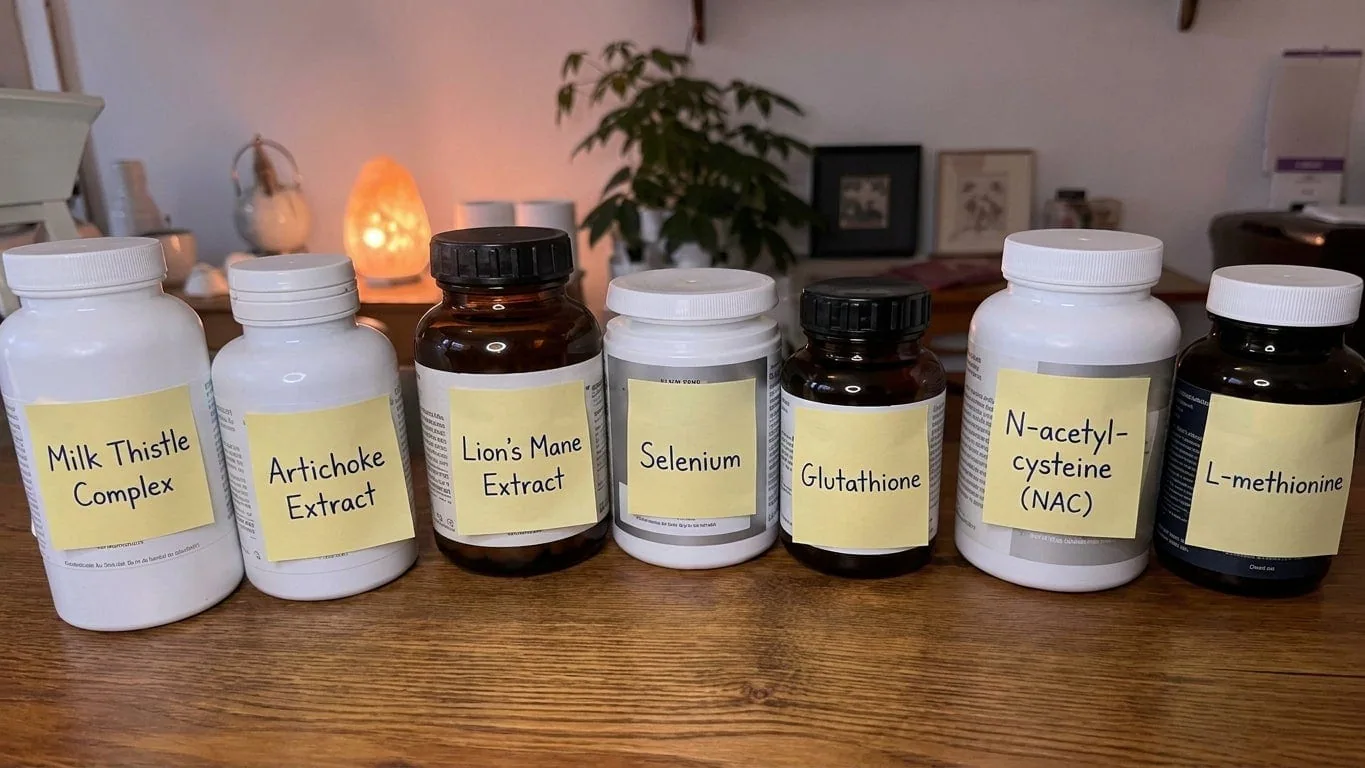
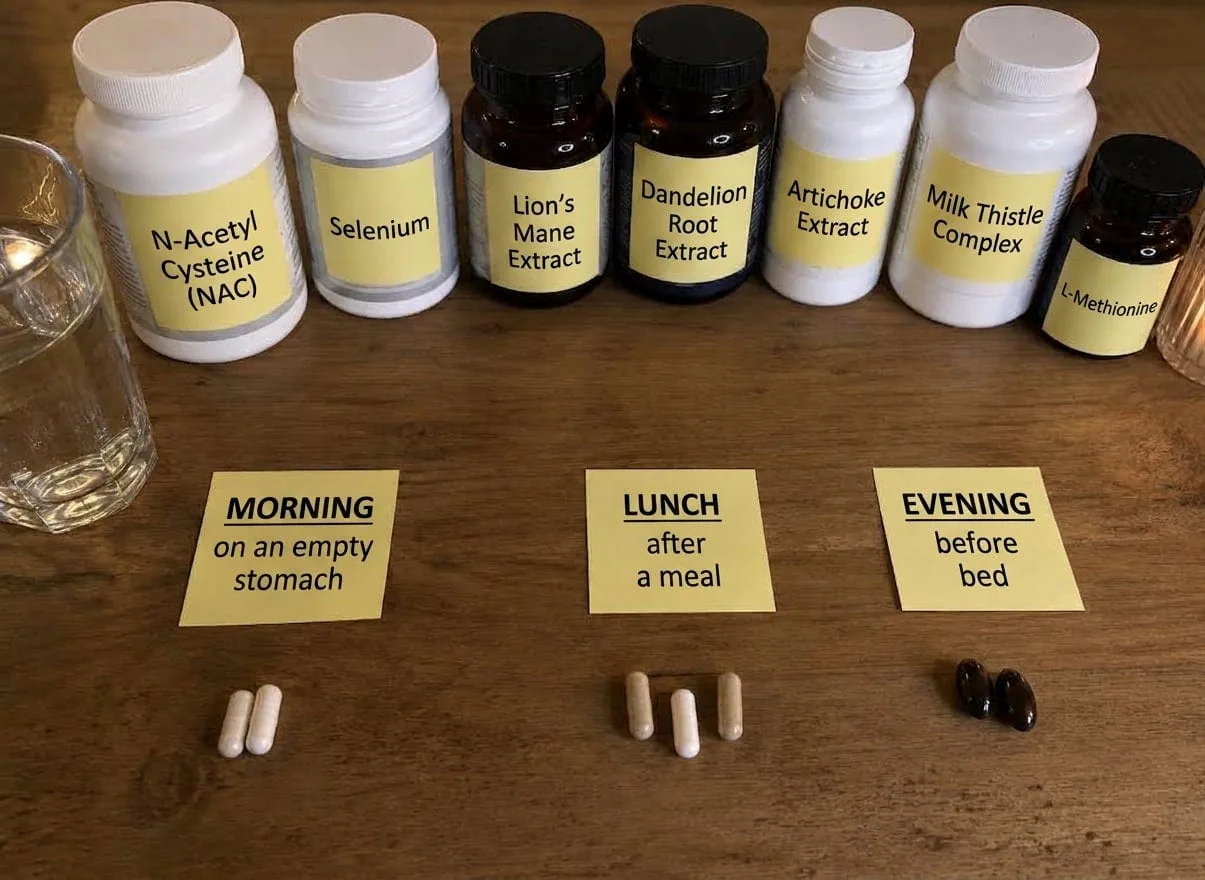
Seven different capsules. Every day.
My kitchen table looked like the shelf in a small pharmacy.
Seven small jars.
One before food, the second after, the third preferably on an empty stomach in the morning.
My husband just looked at me and shook his head:
"You won't last two weeks with that."
But I was stubborn.
After 2 weeks something happened
I suddenly slept all night .
For the first time in years, I no longer woke up at three in the morning.
No mind-bending.
No tired dragging yourself out of bed in the morning.
I just woke up.
Rested.
It was so unexpected that I could hardly believe it.
My husband asked at breakfast:
"You seem more alert today."
I smiled honestly for the first time in a long time.
After 4 weeks, my afternoon slump disappeared
Anyone who knows me knows: my afternoon slump was legendary.
After four weeks it was just gone.
Simply disappeared.
But then came the problem
Seven intakes.
Some capsules I have to remember to take on an empty stomach. Others with food.
I quickly lost track of things.
And my account too.
Over NZ$1,400 per month.
The last piece of the puzzle
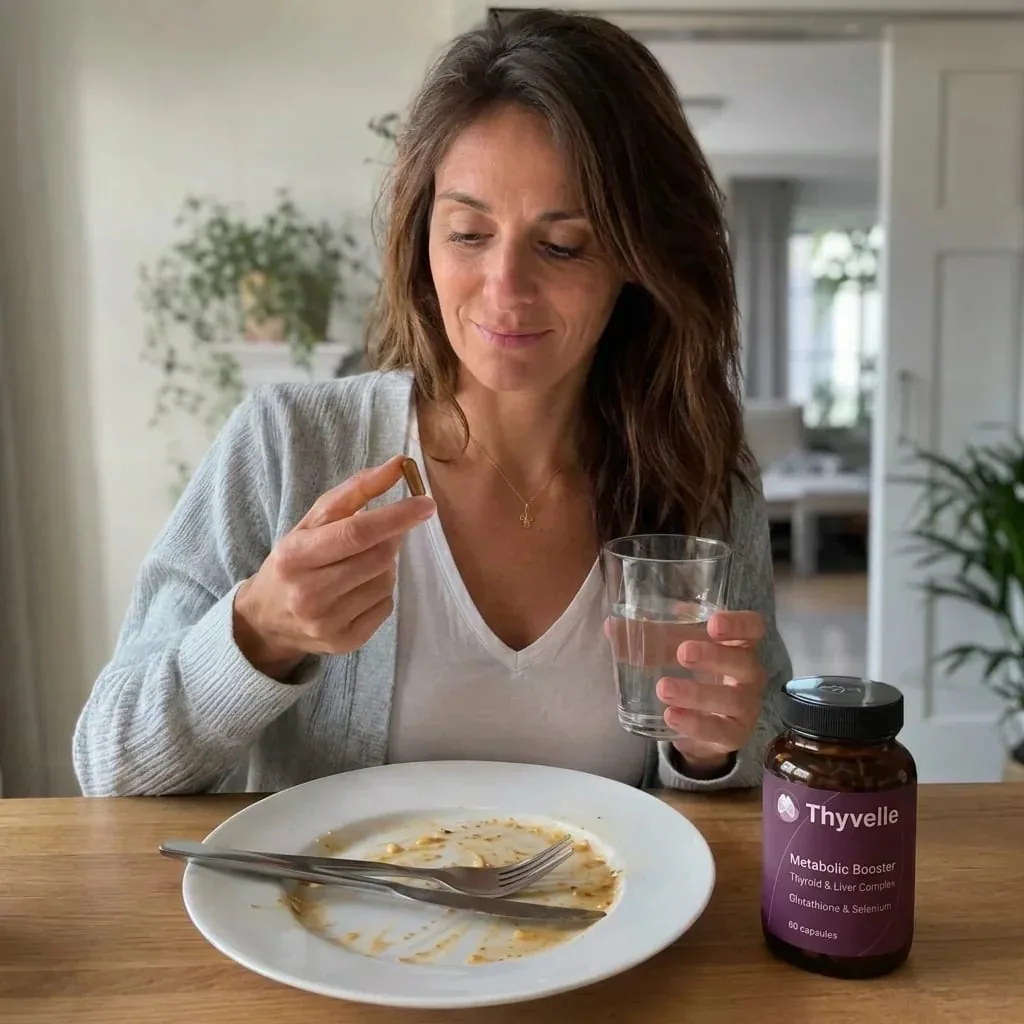
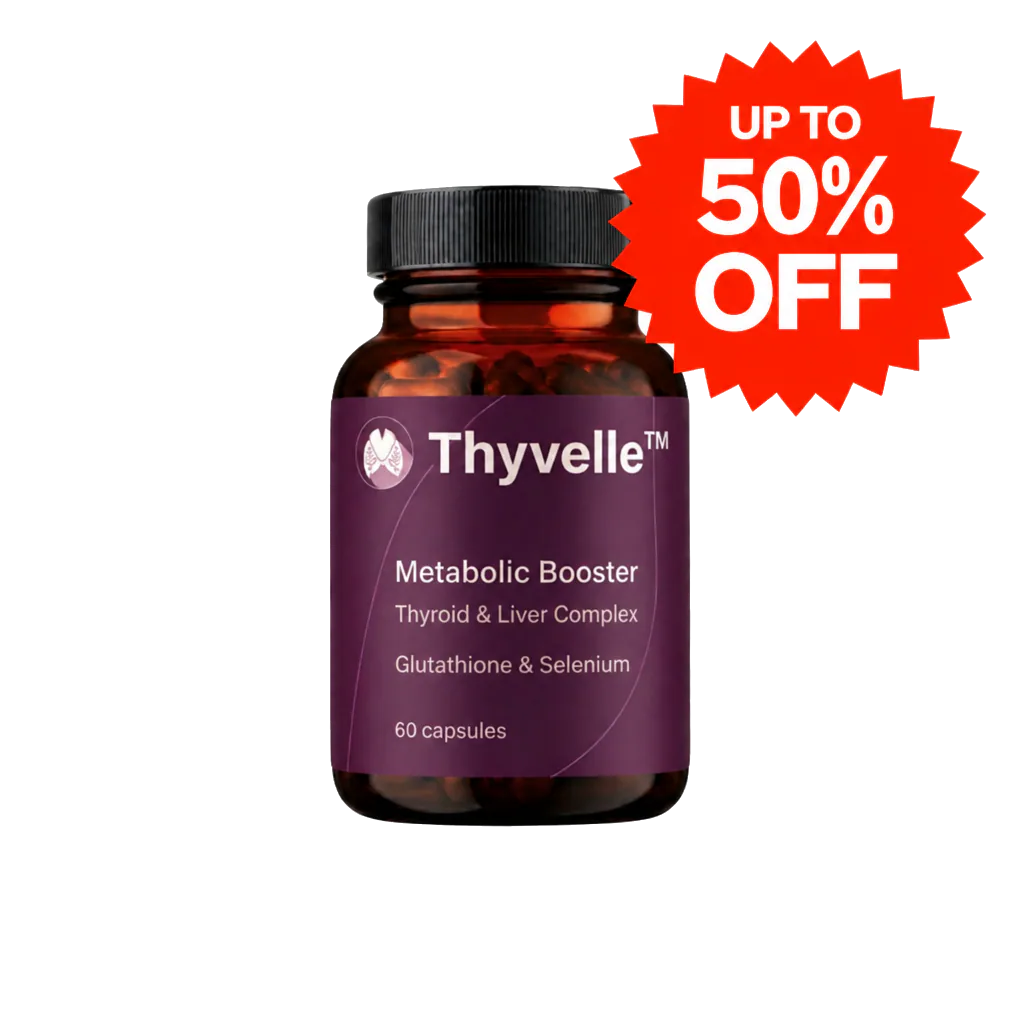
And over and over again, one name appeared: Thyvelle .
A woman from Hamilton wrote that she was finally able to reduce her tablets .
I was sceptical.
So I dug.

Thyvelle is an Auckland-based start-up that specialises exclusively in a single disease:
Hypothyroidism.
They have developed a product whose name says it all:
Thyvelle.
Just the name made me curious.
I looked at the contents:
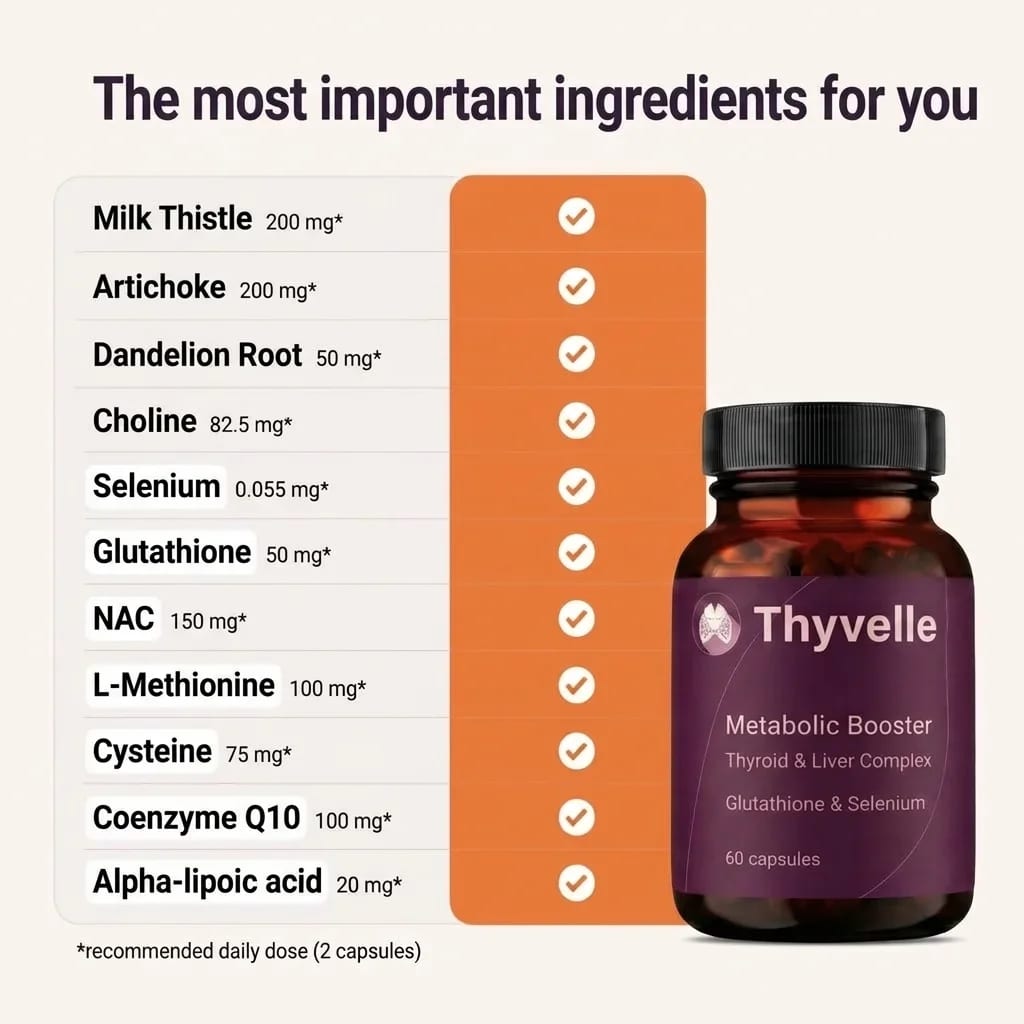
What I saw there made me shiver.
And the price?
a fraction of what I paid for separate supplements
Let it sink in.
Thyvelle cost just NZ$104.99for the full 3-month supply.
Less than one takeaway coffee a day!
But does it really work?
After 8 weeks
I could barely comprehend it myself.
My favourite jeans, which had been hanging in the back of my closet for three years, fit again.
I stood in front of the mirror for ten minutes, twisting back and forth.
My husband came into the room, looked at me and said:
"You shine."
After 4 months – the second blood test
This time with a beating heart.
Would the values confirm what I felt every day?
A week later I had the results in my hand:
My cholesterol was below 5.2
I sat in the car park outside the health centre and cried.
But this time not out of despair.
This time out of relief.
My life today
Colleagues at work ask:
"Anna, what are you doing differently? You look amazing."
Without an afternoon slump.
Without that fog in my head.
I sleep all night.
Every night.
And the best thing:
My husband notices me again in the evenings.
Puts his hand on mine when we sit on the couch.
Kisses me before we fall asleep.

My research became the biggest article of my career
I wrote the story.
Just like I told it to you here.
I just want to show you three of them briefly:
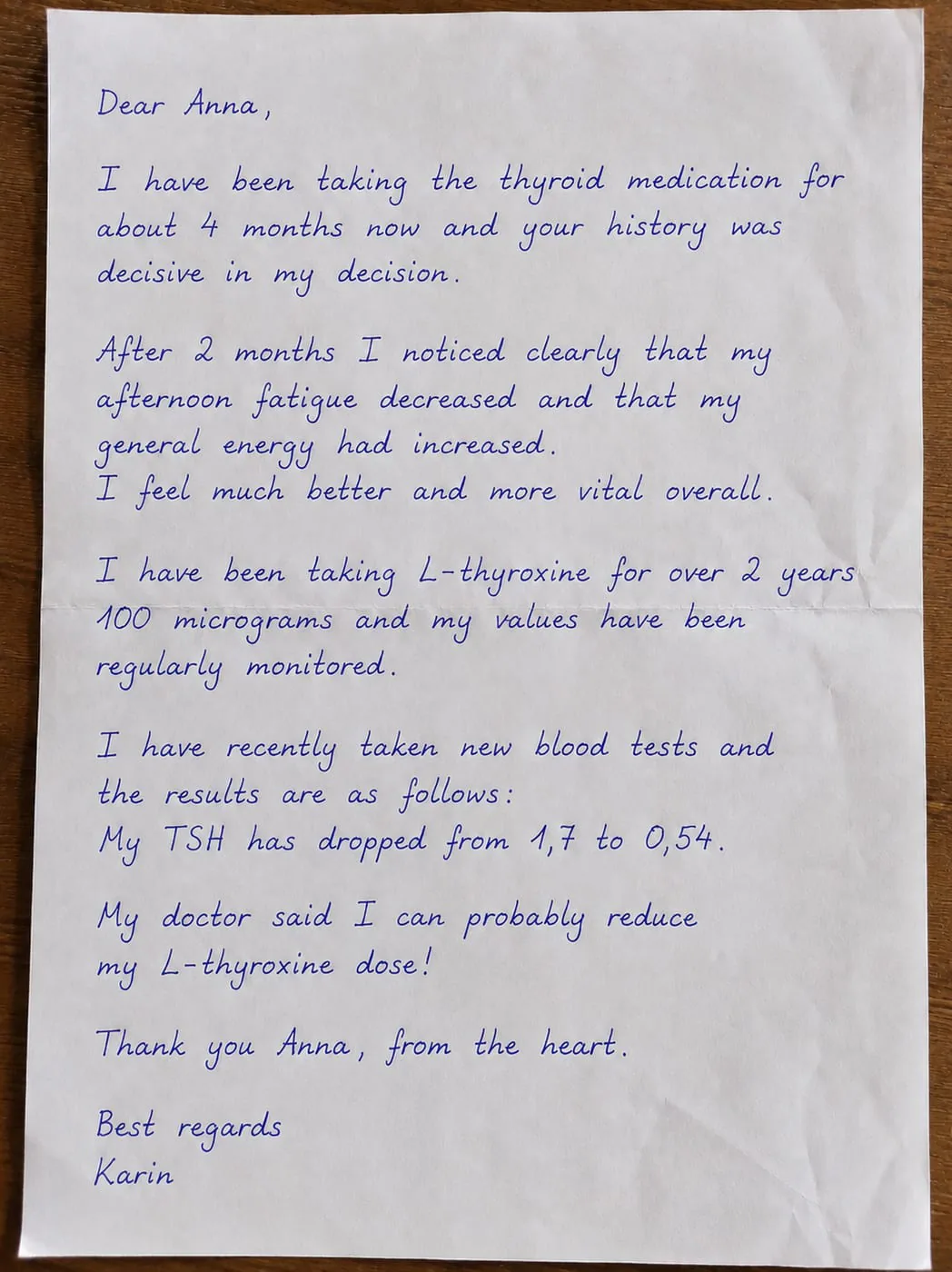
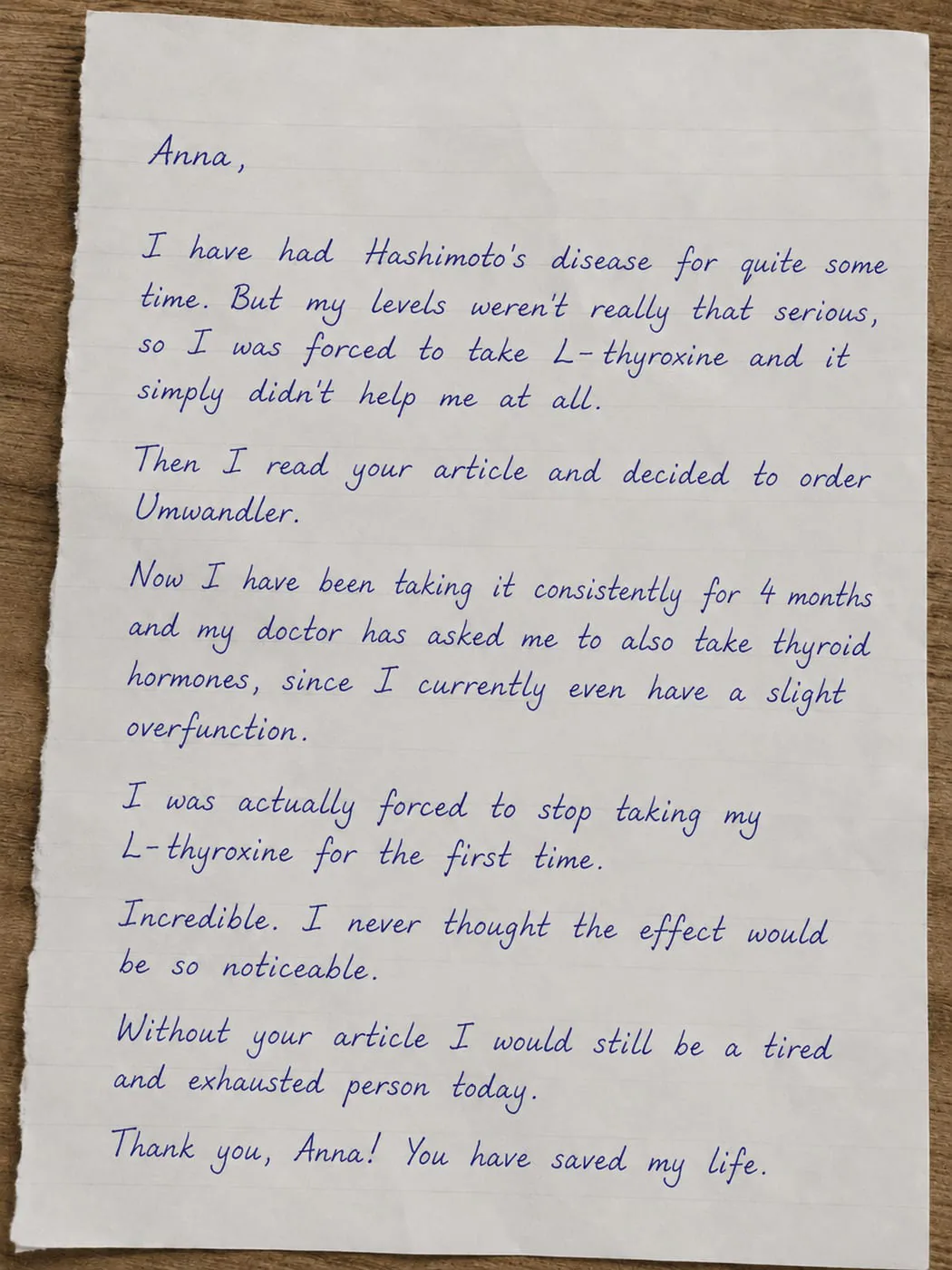
Because I know what you're going through.
I know what it means when doctor after doctor says:
"Your values are completely normal."

One thing you need to know
Before I give you the final piece of advice, I need to clarify one thing:
I wrote this article for a single person:
For you.
No ifs and buts.
If it doesn't work – you get a full refund.
Exclusive discount for my readers
Because I'm sharing this story with you, I want to make sure you don't miss the discount the manufacturer is currently running.
Right now that discount is live through this article and on the Thyvelle website.
This means that Thyvelle in a 3-pack costs you just over NZ$1 a day.
Less than a takeaway coffee.
My personal advice in the end:
Then you need to understand something important now:
No one will help you
No doctor.
No partner.
No miracle.
Just you.
You now have two options.
Option 1:
You continue as before.
High blood pressure, diabetes, depression or osteoporosis.
Option 2:
You take responsibility.
For your body. For your life.
For the person you once were.
Which path you take is up to you.
But think about one thing:
Warm regards, Anna Whitemore

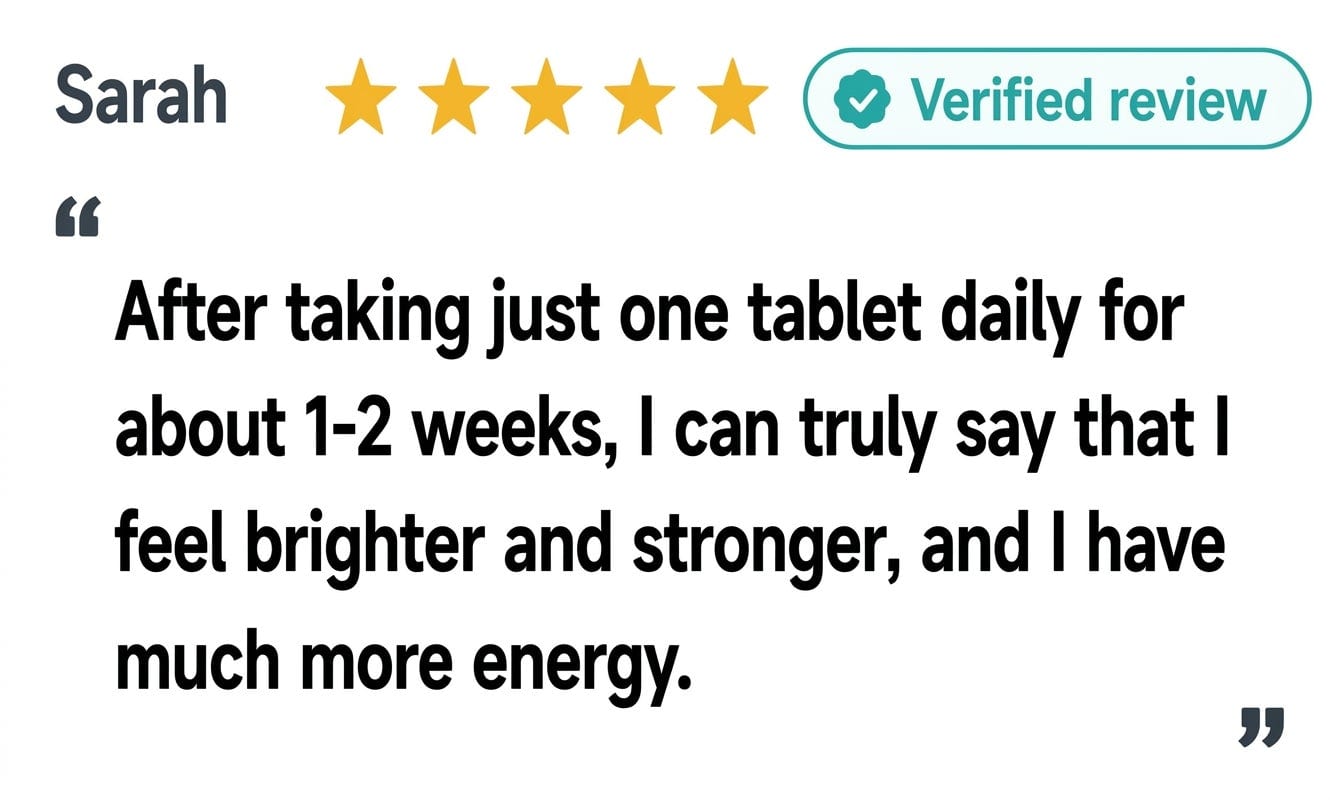
Verified reviews:





Helen Fraser
I’d been feeling completely drained lately and honestly thought it was just something I’d have to put up with. After about a week with Thyvelle, I started noticing I wasn’t waking up feeling quite so exhausted. Didn’t expect to notice a difference that quickly.
Like · Comment ·

14 · 3 hrs
Like · Comment ·
4 · 50 min
Like · Comment ·
14 · 3 hrs

Troy Sinclair
Was pretty sceptical at first because I’ve tried a few different supplements that did absolutely nothing for me. But after sticking with Thyvelle for a couple of weeks, I’m waking up feeling more refreshed and actually have more energy to get through the day. Definitely keeping this in my routine.
Like · Comment ·
21 · 6 hrs
Like · Comment ·
4 · 50 min
Like · Comment ·
21 · 6 hrs
Susan Blackwell
I'd got so used to feeling sluggish in the mornings that I didn't realise how much it was affecting me. Thyvelle has been really easy to add to my daily routine and I’ve noticed I feel much more refreshed lately. Wish I’d tried it sooner.
Like · Comment ·
11 · 9 hrs
Like · Comment ·
4 · 50 min
Like · Comment ·
11 · 9 hrs

Mick Reed
Has anyone else noticed a difference in their energy with this? I’ve been feeling unusually tired for months and finally decided to give Thyvelle a proper try. Only been using it for a short while but mornings already feel a lot easier.
Like · Comment ·
4 · 14 hrs
Like · Comment ·
4 · 50 min
Like · Comment ·
4 · 14 hrs

Damo Bennett
Mick, yes! I was in exactly the same boat. I started taking Thyvelle every morning and after the first week I noticed I wasn’t dragging myself through the day anymore. Nothing complicated, just feeling more like myself again.”
Like · Comment ·
11 · 10 hrs
Like · Comment ·
3 · 50 min
Like · Comment ·
11 · 10 hrs

Patricia Dunne
The biggest thing I’ve noticed is how much better I feel when I wake up. I used to dread getting started in the morning, but lately I’ve been getting up feeling much more refreshed. Really glad I decided to give Thyvelle a proper try.
Like · Comment ·
17 · 2 days
Like · Comment ·
4 · 50 min
Like · Comment ·
17 · 2 days
Limited offer for readers:

The information and other content on this page, or in associated materials, is not intended and should not be construed as medical advice, nor is the information a substitute for professional medical expertise or treatment.
If you or anyone else has a medical problem, you should consult your healthcare provider or seek other professional medical care. Never ignore or delay seeking professional medical advice because of anything you have read on this site or in associated materials. If you think you have a medical emergency, call your doctor or 111 immediately.
Copyright © 2026. All rights reserved.